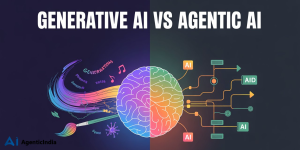
The financial services sector is in the middle of a significant transformation, one playing out not at tech conferences but across trading desks, compliance teams, and customer onboarding workflows at institutions worldwide.
By 2027, AI in financial services is no longer a pilot program or a future bet. For firms still deliberating on strategy, the question is no longer whether to adopt AI, but how fast to scale and which use cases move the needle.
This article breaks down the most important AI trends shaping financial services heading into 2027, backed by current data and grounded in what is being deployed.
Key AI Adoption Statistics in Financial Services (2026-2027)
| Metric | Figure | Source |
| Global AI spend in fintech by 2027 | $22.6 billion | BytePlus Market Report |
| AI in fintech CAGR (2024-2027) | 25.3% | BytePlus Market Report |
| Financial services firms adopting generative AI (2026) | 71% | Cambridge Centre for Alternative Finance |
| Finance teams actively deploying agentic AI (2026) | 52% | Cambridge Centre for Alternative Finance |
| Increase in finance teams using agentic AI vs. 2025 | +600% | Azilen Research 2026 |
| Agentic AI market in financial services (2026) | $7.78 billion | Azilen Research 2026 |
| Agentic AI market projection by 2031 | $43.52 billion (41% CAGR) | Azilen Research 2026 |
| Banks deploying agentic AI for fraud detection (2026) | 70% | Unframe Industry Report |
| Conversational AI in banking market by 2027 | $15.7 billion | BytePlus Conversational AI Report |
| JPMorgan Chase annual technology budget | ~$18 billion | Metavert – Agentic AI for Financial Services |
Why is AI Adoption in Financial Services Accelerating So Rapidly?
For much of the last decade, AI adoption in financial services followed by a familiar arc: a promising proof-of-concept, a cautious rollout, and limited scale. That arc has broken down. Three forces converging at once are driving a pace that most organizations did not expect to see until 2028 or later.
First, underlying technology has matured. Large language models can now read contracts, analyze financial statements, and generate compliance-ready summaries with a depth that was unavailable two years ago. Second, the cost of inaction has become visible.
Firms that moved early on AI are reporting measurable gains in efficiency and margin, creating competitive pressure on those that have not. Third, the regulatory environment, particularly the EU AI Act, is clarifying and removing a common argument for delay.
The Numbers That Frame the Moment
A 2026 survey by the Cambridge Centre for Alternative Finance found that 71% of financial services firms are adopting generative AI, and – more significantly – 52% are actively deploying agentic AI.
Agentic AI, which refers to systems capable of autonomously executing multi-step tasks with minimal human triggering, is in production at more than half of firms that have moved past early-stage adoption. (Source: Ampcome – Agentic AI for Fintech 2026)
The Real Inflection Point Was 2026
McKinsey described 2026 as the year AI moved from “integration to intelligent simplicity” in financial services. Deloitte projects that by 2027, half of all companies using generative AI will have deployed enterprise-grade AI agents. For financial firms, that transition from exploration to execution is already underway, and it is compressing timelines for everyone in the sector. (Source: Insight Global – 2026 Financial Services Trends)
What Is Agentic AI and Why Should Financial Firms Pay Attention?
Most firms have hands-on experience with AI in narrow, well-defined tasks: a chatbot that handles account queries, a fraud model that flags suspicious transactions, a tool that speeds up document review. Agentic AI is categorically different, and the distinction matters how firms should be planning right now.
An AI agent does not simply respond to instructions – it pursues goals. It gathers information, makes decisions across multiple steps, executes workflows, and adapts when circumstances change, all without a human triggering each action individually. In a financial context, that means an agent capable of handling a full KYC onboarding workflow – from document collection to risk scoring to regulatory filing – without a human touching it unless an exception surfaces.
Why Financial Services Is the Highest-Leverage Environment for Agents?
Financial workflows are process-dense, data-rich, and heavily regulated. That combination – rule-based requirements that AI can follow consistently, plus transaction volumes large enough to make scale advantages enormous – makes finance uniquely suited to agentic deployment.
The agentic AI market in financial services was estimated at $7.78 billion in 2026, with projections placing it at $43.52 billion by 2031 at a 41% CAGR. This is a structural shift in how financial operations are staffed and run, not a technology upgrade cycle. (Source: Azilen – Agentic AI in Finance Services 2026)
The operating model gaining traction at leading institutions is AI handling around 95% of a workflow autonomously, with human experts managing the exceptions, judgment calls, and regulatory accountability – and having full context when they do.
Which AI Use Cases Are Generating the Most Value in 2027?
Not all AI investments deliver equal returns. Firms reporting the clearest ROI share one characteristic: they target specific, high-volume, regulated workflows rather than building general-purpose AI capability first and finding applications later. The table below captures where the highest returns are currently being reported across the sector.
Top AI Use Cases in Financial Services – ROI Overview
| Use Case | What AI Does | Primary Benefit | Adoption Level |
| Fraud Detection and AML | Real-time pattern analysis across transactions and behavioural signals | 70% of banks deploying; lower false positives, reduced analyst workload | Very High |
| KYC and Customer Onboarding | End-to-end document verification, risk scoring, regulatory filing | Onboarding time reduced from days to hours at scale | High |
| Credit Decisioning | Automated underwriting using alternative and traditional data signals | Faster approvals, improved accuracy, lower default rates | High |
| Wealth Management | Personalised recommendations, real-time portfolio rebalancing | Advisory-quality service extended to mass-affluent clients | Growing |
| Regulatory Reporting | Automated data aggregation, format compliance, audit trail generation | Reduced compliance cost and lower human error risk | High |
| Conversational Client Services | LLM-powered advisors handling complex queries at scale | $15.7B market by 2027; lower call centre volume | Very High |
Fraud Prevention: The Most Mature Deployment Area
Fraud detection was among the earliest serious AI deployments in finance, and it remains the most mature. 70% of banking institutions are now using agentic AI specifically for fraud and security use cases. The reason is straightforward: fraudsters operate across multiple institutions simultaneously, and real-time cross-channel pattern recognition is something only AI can deliver at the required speed and coverage. Human review teams cannot match it at scale. (Source: Unframe – 5 AI Use Cases in Financial Services 2026).
Compliance Automation: The Fastest-Growing Priority
KYC and AML compliance are among the most labour-intensive functions in financial services – and they represent one of the clearest AI wins. Our agentic automation services execute full verification of workflows end-to-end, routing exceptions to human reviewers while processing the bulk autonomously.
This is especially impactful for institutions operating across jurisdictions with differing regulatory requirements, where manual compliance creates simultaneous cost and error exposure.
Hyper-Personalization at the Mass-Affluent Level
Historically, personalized financial advisory was economically viable only for high-net-worth clients. AI is changing that calculus. By 2027, AI-driven wealth platforms are using real-time behavioral data, life event signals, and market conditions to deliver continuously updated personalized guidance to customers who would never have accessed a human advisor. The conversational AI market in banking is projected to reach $15.7 billion by 2027, representing a CAGR of 26.7%. (Source: BytePlus – Conversational AI for Fintech 2027)
How Is Regulation Shaping AI Strategy in Financial Services?
The regulatory environment around AI in financial services is clarifying faster than many anticipated. Firms treating compliance as a brake on AI adoption are misreading the situation. The deadlines are real, but firms building compliance infrastructure now are finding it to be a source of competitive advantage rather than a cost.
AI Regulatory Timeline for Financial Services (2026-2027)
| Deadline | Regulation / Body | Requirement | Who It Affects |
| August 2027 | EU AI Act – Final Compliance | High-risk AI systems must meet documented standards for transparency, accuracy, human oversight, and robustness | All firms operating in or serving EU markets |
| Late 2027 | G20 Financial Stability Board | Accountability checkpoint for cross-border payment AI systems under G20 Roadmap | Global financial institutions with cross-border operations |
| 2026 onwards | Explainable AI Mandates | AI predictions used in credit and fraud decisions must be transparent, auditable, and explainable to regulators and customers | Banks and lenders using AI in customer-facing decisions |
| 2026 onwards | GDPR – AI Alignment | AI systems processing personal financial data must comply with data minimization and purpose limitation principles | All EU-serving financial firms processing personal data |
What the EU AI Act Means for Financial Firms
The EU AI Act’s final compliance deadlines arrive in August 2027. For financial services, this sets a non-negotiable floor: high-risk AI applications – which includes most credit assessment, identity verification, and insurance underwriting systems – must meet documented standards for transparency, human oversight, accuracy, and robustness. Explainable AI shifts from best practice to legal requirement. (Source: Insight Global – 2026 Financial Services Trends)
This is not purely a European concern. Global financial institutions typically apply the most stringent applicable standard across all their operations. The EU AI Act effectively sets a global governance baseline for AI in financial services. The G20 Financial Stability Board has its own accountability checkpoint for cross-border payment systems arriving in late 2027, adding a second layer of governance pressure.
Explainable AI as a Product Advantage, Not Just a Compliance Checkbox
Counterintuitively, firms that invested early in explainable AI frameworks are finding them to be business advantages. When an AI-driven credit decision can be explained clearly and audited completely, it builds client trust, reduces dispute resolution costs, and creates a defensible record for regulators. Compliance infrastructure and commercial value are, in this case, pointing in the same direction.
What Should Financial Firms Actually Do in 2027?
Strategy without execution is just commentary. For financial services firms ready to convert AI opportunity into competitive advantage, the path is clearer than it has ever been.
Start with High-Volume, Regulated Workflows
The institutions generating the clearest AI ROI are not those that built the most sophisticated models – they are those that deployed AI against specific, high-volume workflows where performance baselines were measurable and scale was large enough to matter. KYC, fraud detection, and underwriting are the proven starting points. The ROI case is established, the infrastructure patterns are documented, and the regulatory requirements are well understood.
Build Governance Infrastructure Before You Scale
Firms best positioned for 2027 and beyond are building AI governance now: audit trails, human-in-the-loop escalation paths, model performance monitoring, and explainability layers. These are not afterthoughts – they are the foundation that allows AI to scale without accumulating regulatory or reputational risk.
Key Takeaways
The talent constraint in financial AI is not engineers – it is domain experts who can define the right use cases, evaluate model outputs intelligently, and manage AI systems effectively across risk, compliance, and client-facing functions. Investing in AI literacy across these roles is as important as any technology investment. The firms that will lead in 2027 are those where the risk officer, the compliance head, and the relationship manager all understand what AI can and cannot do in their specific context.
FAQs
What is the biggest AI trend in financial services heading into 2027?
The most significant trend is the industrialization of agentic AI – autonomous systems that manage complex financial workflows end-to-end without manual triggering at each step. By 2027, Deloitte projects that half of all generative AI adopters will have deployed enterprise AI agents, with financial services leading in compliance, fraud, and wealth management deployments. Agentic AI adoption among finance teams grew by over 600% between 2025 and 2026 alone.
How is AI changing fraud detection in banks and financial institutions?
AI enables real-time analysis of transaction patterns, behavioral signals, and cross-institution data at speeds and scales that human analysts cannot match. Seventy percent of banking institutions are now deploying agentic AI specifically for fraud detection and security. This reduces false positives significantly while improving detection rates for sophisticated schemes that span multiple institutions simultaneously.
What does the EU AI Act mean for financial firms using AI?
The EU AI Act’s final compliance deadlines arrive in August 2027. For financial services, it mandates that high-risk AI systems – including credit assessment, identity verification, and insurance underwriting – meet documented standards for transparency, accuracy, and human oversight. Because global institutions apply the strictest applicable standard across operations, this effectively sets a worldwide compliance baseline for AI in finance, not just a European one.
Is AI replacing human professionals in financial services?
AI is automating specific, high-volume tasks rather than replacing professional judgment broadly. The model gaining traction at leading institutions is AI handling around 95% of a workflow autonomously, with human experts managing the exceptions, judgment calls, and regulatory accountability. Roles are evolving compliance analysts, relationship managers, and risk officers are shifting toward oversight, exception handling, and strategy rather than repetitive data processing.
How large is the AI market in financial services and how fast is it growing?
Global AI spending in fintech is projected to reach $22.6 billion by 2027 at a 25.3% CAGR. The agentic AI segment is expected to grow from $7.78 billion in 2026 to $43.52 billion by 2031 at a 41.12% CAGR, indicating that growth is accelerating rather than plateauing. Financial services currently generates more advanced AI deployments per firm than any other industry sector.
About the Author