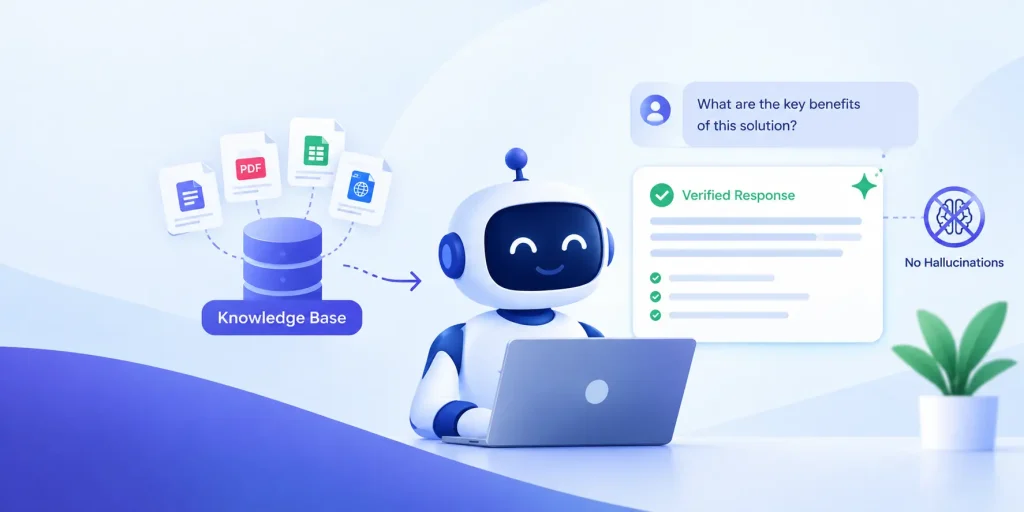
Generative AI has transformed how businesses build customer support assistants, enterprise search systems, internal knowledge bases, and virtual advisors. Instead of relying on predefined scripts, modern chatbots powered by Large Language Models (LLMs) can understand natural language, summarize documents, answer complex questions, and generate conversational responses in seconds.
To make these systems more accurate, organizations increasingly adopt Retrieval-Augmented Generation (RAG). Rather than depending solely on an LLM’s training data, a RAG architecture retrieves relevant information from trusted business documents, databases, or knowledge repositories before generating an answer.
While this significantly improves response quality, it doesn’t eliminate inaccuracies. Businesses still encounter situations where the chatbot confidently provides information that isn’t supported by the retrieved documents, which appear convincing. These incorrect outputs are commonly known as hallucinations.
This guide explains why hallucinations occur in RAG development services, how they affect business outcomes, and the most effective hallucination reduction RAG strategies for improving response accuracy.
Understanding Hallucinations in RAG-Based Chatbots
Many people assume that adding Retrieval-Augmented Generation automatically eliminates hallucinations. While RAG significantly improves factual accuracy compared to standalone language models, it doesn’t guarantee that every response will be correct. AI hallucinations remain a major barrier to enterprise adoption, with error rates reaching up to 40% in critical tasks.
A hallucination occurs when the chatbot generates information that cannot be verified using the retrieved context or introduces details that simply do not exist. Sometimes the response sounds logical and well-written, making it difficult for users to recognize that the information is inaccurate.
What Causes Hallucinations in a RAG Pipeline?
Several factors contribute to inaccurate responses.
Poor Document Retrieval
A RAG system is only as reliable as the information it retrieves. If the retrieval engine fails to identify the most relevant documents, the language model has little factual context to work with.
This often happens when embeddings fail to capture semantic meaning, search queries are ambiguous, or document indexing is incomplete. As a result, the chatbot may retrieve partially relevant content.
When retrieval quality declines, hallucination rates increase naturally because the model attempts to compensate for missing information.
Weak Document Chunking
Large business documents are typically divided into smaller sections before being indexed. However, poor chunking strategies frequently remove critical context.
Imagine a company policy where the eligibility requirements appear in one section while the exceptions appear in another. If those sections are separated into different chunks, the retrieval engine may only return half of the required information.
The language model then tries to bridge the missing context, increasing the likelihood of inaccurate or misleading responses.
Outdated Knowledge Sources
Many organizations continuously update product documentation, pricing, policies, compliance rules, and technical manuals.
If the chatbot indexes outdated documents, users may receive obsolete information even when the retrieval system works perfectly.
For example, a customer asking about your latest subscription plans expects current pricing. Maintaining synchronized knowledge repositories is essential for improving chatbot reliability.
Ambiguous User Queries
Sometimes the issue isn’t the Gen AI development services model or retrieval engine; it’s the question itself.
Broad questions such as:
“Tell me about enterprise security.”
can refer to authentication, compliance, encryption, access control, infrastructure, or data governance.
Without clarification, the retrieval engine may surface multiple partially relevant documents, forcing the model to infer what the user actually meant. Clarifying ambiguous queries before retrieval significantly improves response quality.
Overconfident Language Models
Even when retrieval fails, many language models are naturally optimized to produce fluent responses. Without carefully designed prompting and response policies, the chatbot may confidently generate information that appears correct despite lacking supporting evidence.
One of the simplest yet most effective RAG hallucination evaluation is teaching the model to respond with statements such as:
“I couldn’t find enough information in the available knowledge base to answer that accurately.”
Although less conversational, this approach builds far greater trust than confidently delivering incorrect information.
Proven Strategies for Hallucination Reduction RAG Systems
Let’s explore the techniques for hallucination reduction RAG strategies that have the biggest impact.
Improve Retrieval Quality Before Optimizing the Language Model
Many organizations immediately start experimenting with prompts or replacing their language model when hallucinations appear. However, in most RAG implementations, the root cause lies much earlier in the pipeline.
The language model can only generate responses based on the information it receives. If retrieval brings back incomplete, outdated, or irrelevant content, even the most advanced LLM will struggle to produce accurate answers.
This is why improving retrieval quality should always be the first optimization priority.
Instead of simply retrieving the top three documents, evaluate whether those documents truly answer the user’s question. Ask questions such as:
- Are the retrieved documents relevant?
- Are they the latest versions?
- Do they contain enough context?
- Are duplicate documents being returned?
- Is important information missing?
Organizations that regularly audit retrieval performance often discover that hallucinations decrease significantly before making any changes to prompts or models.
Choose Smarter Document Chunking Instead of Fixed-Length Splits
One of the most overlooked causes of hallucinations is poor document chunking.
Before documents are stored in a vector database, they are usually divided into smaller sections called chunks. If these chunks are created without considering the document’s structure, important relationships between paragraphs can be lost.
A more effective approach is semantic chunking, where content is grouped based on meaning rather than a fixed number of words or characters.
Businesses should also use overlapping chunks so related information appears in multiple sections. This preserves context during retrieval and gives the language model a more complete understanding of the source material.
Better chunking creates stronger context, and stronger context naturally leads to more accurate responses in hallucination reduction RAG.
Use Hybrid Search Instead of Vector Search Alone
Vector search is excellent at identifying semantically similar content, but it isn’t always enough. Especially when users ask questions containing exact product names, technical terms, policy numbers, or legal references.
For instance, imagine a customer searching for:
“What are the limits of Premium Plan 3.2?”
A vector search engine might retrieve documents discussing premium plans in general but overlook the exact version number. Because it focuses on meaning rather than precise keyword matching.
Hybrid search combines two retrieval methods:
- Vector Search for semantic similarity.
- Keyword Search (BM25 or lexical search) for exact matches.
Together, these approaches produce more balanced and accurate search results.
Many enterprise AI platforms have adopted hybrid retrieval because it improves document recall without sacrificing semantic understanding. By returning documents that are both contextually relevant and keyword-specific, businesses can significantly reduce incorrect AI-generated responses.
Strengthen RAG Hallucination Grounding with Verified Sources
One of the most effective RAG hallucination grounding techniques is ensuring that every generated response is tied directly to trusted business content.
Grounding means the chatbot should answer questions using retrieved documents rather than relying on assumptions or general knowledge stored within the language model.
Instead of asking the model to “answer the question,” instruct it to:
- Use only the provided context.
- Never invent missing information.
- Clearly state when supporting information isn’t available.
- Reference the relevant document whenever possible.
For example, instead of responding:
“The warranty lasts for three years.”
Apply Metadata Filtering for More Relevant Results
As business knowledge bases grow, multiple versions of similar documents often exist.
Without metadata filtering, the retrieval engine may return:
- Archived policies
- Draft documentation
- Internal-only documents
- Region-specific information
- Duplicate product manuals
Even if these documents are technically relevant, they may not represent the correct answer for the user. You can hire Agentic AI developers to apply metadata carefully.
Metadata filtering allows organizations to retrieve documents based on specific attributes such as:
- Publication date
- Language
- Product version
- Business unit
- Geographic region
- Customer segment
- Document approval status
Improve Prompt Design to Prevent Unsupported Responses
Prompt engineering remains an important part of RAG hallucination mitigation techniques, but prompts should reinforce retrieval rather than replace it.
A well-designed system prompt encourages the language model to behave responsibly when information is missing.
For example, your prompt can include instructions such as:
- Answer only using the retrieved context.
- If the answer cannot be found, acknowledge the limitation instead of guessing.
- Do not combine external knowledge with retrieved documents.
- Keep responses concise and factual.
- Mention supporting documents whenever appropriate.
These simple instructions are hallucination reduction RAG strategies for the model’s tendency to generate plausible but unsupported information.
Select Embedding Models That Match Your Business Domain
Embeddings determine how documents and user queries are represented within a vector database.
Generic embedding models perform well for broad topics but may struggle with specialized industries such as banking, healthcare, legal services, or manufacturing.
For example, financial terms like “credit exposure,” “loan restructuring,” or “AML reporting” have meanings that differ from everyday language.
Choosing embedding models trained on domain-specific data improves semantic understanding and increases the likelihood that relevant documents are retrieved.
Organizations should also periodically evaluate new embedding models as AI technology evolves. Small improvements in retrieval quality often have a significant impact on chatbot accuracy.
Optimize Context Windows Without Overloading the Model
A common misconception is that providing more documents automatically improves response quality.
In reality, too much context can overwhelm the language model.
When dozens of partially relevant documents are included, the chatbot may struggle to identify the most important information, leading to inconsistent or incomplete answers.
Instead of maximizing context size, focus on maximizing context relevance.
Include only the highest-quality documents that directly support the user’s question. This approach allows the model to process information more effectively while reducing distractions caused by unrelated content.
A smaller, highly relevant context window is often more valuable than a large collection of loosely related documents.
Build a Framework for RAG Hallucination Evaluation
That’s why RAG hallucination mitigation techniques should become an ongoing process instead of a one-time testing activity before deployment.
Measure More Than Accuracy
Many businesses evaluate chatbot performance by checking whether the final answer appears correct. While accuracy is important, it doesn’t tell the complete story.
| Evaluation Metric | Why It Matters |
| Groundedness | Confirms whether the answer is fully supported by the retrieved documents. |
| Context Relevance | Measures how closely the retrieved information matches the user’s query. |
| Answer Relevancy | Evaluates whether the chatbot actually answered the user’s question. |
| Faithfulness | Detects whether the model introduced facts that don’t exist in the retrieved content. |
| Citation Accuracy | Verifies that referenced documents genuinely support the response. |
| Completeness | Ensures important information hasn’t been omitted. |
A response may look accurate but still contain unsupported assumptions. Similarly, a partially correct answer may omit critical business information, leading users to make incorrect decisions.
To perform meaningful RAG hallucination mitigation techniques, consider measuring multiple aspects of the response.
Keep Your Knowledge Base Fresh and Well Maintained
Even a perfectly designed retrieval pipeline will struggle if the underlying knowledge base is outdated or poorly organized.
Businesses frequently update pricing, product documentation, policies, FAQs, technical manuals, compliance requirements, and internal procedures. If these updates aren’t reflected in the chatbot’s knowledge base, users may receive obsolete information despite successful retrieval.
Treat your knowledge repository as a living resource.
Establish processes to:
- Remove outdated documents.
- Archive older versions appropriately.
- Update content after every product release.
- Standardize document formatting.
- Eliminate duplicate information.
- Review knowledge quality regularly.
Maintaining a clean knowledge base reduces retrieval errors and improves response consistency over time.
Add Human Review for High-Risk Responses
Not every AI-generated answer should be delivered without oversight.
In industries such as banking, insurance, healthcare, legal services, and enterprise software, certain responses have significant financial or regulatory implications. These situations benefit from a human review process.
For example:
- Investment recommendations
- Loan eligibility explanations
- Insurance claim decisions
- Legal compliance guidance
- Medical information
- Contract interpretation
Instead of automatically responding, the chatbot can flag high-risk queries for review or clearly indicate that a human specialist will verify the information.
This hybrid approach balances automation with accountability and helps organizations build greater confidence in AI-assisted workflows.
Use Customer Feedback to Improve Retrieval
Your users can become one of the most valuable sources of improvement.
Every chatbot interaction generates useful signals about retrieval quality and response accuracy. Questions that receive low satisfaction ratings, repeated follow-up requests, or manual escalations often reveal weaknesses in the RAG pipeline.
Businesses should regularly analyze:
- Frequently unanswered questions
- Queries resulting in customer dissatisfaction
- Responses corrected by support agents
- Search terms with poor retrieval performance
- Documents that rarely appear despite being relevant
These insights help prioritize improvements and refine both retrieval and prompting strategies.
Instead of treating customer feedback as a support metric, use it as training data for continuous optimization.
Establish a Continuous Improvement Cycle
Hallucination reduction RAG isn’t a one-time project; it requires ongoing refinement.
As your products evolve, regulations change, and customer expectations shift, your chatbot must adapt as well.
An effective improvement cycle typically includes:
- Collect chatbot conversations.
- Identify inaccurate or incomplete responses.
- Analyze whether retrieval or generation caused the issue.
- Update documents, prompts, or retrieval settings.
- Re-evaluate performance using predefined metrics.
- Deploy improvements and continue monitoring.
This iterative approach ensures that your chatbot becomes more reliable over time rather than gradually losing accuracy.
Organizations that treat Agentic AI consulting services as an evolving business capability generally achieve better long-term results than those that view deployment as the final step.
Best Practices for Reducing Hallucinations in RAG-Based Chatbots
If you’re planning to build or improve a RAG-powered chatbot, keep these best practices in mind:
- Define clear response policies that discourage unsupported answers.
- Use trusted, well-maintained knowledge sources.
- Implement semantic chunking with overlapping context.
- Combine vector search with keyword-based retrieval.
- Apply metadata filtering to retrieve the most relevant documents.
- Use reranking models to improve document selection.
- Ground responses using retrieved content instead of model assumptions.
- Encourage the chatbot to acknowledge uncertainty when information is unavailable.
- Evaluate chatbot performance using groundedness, faithfulness, and context relevance metrics.
- Monitor conversations continuously and improve the system based on real user interactions.
Conclusion
Retrieval-Augmented Generation has significantly improved the reliability of enterprise AI chatbots, but retrieval alone isn’t enough to eliminate hallucinations.
Organizations must look beyond the language model and optimize every layer of the RAG architecture from document preparation and retrieval to grounding, prompting, evaluation, and continuous monitoring.
The most successful businesses treat hallucination reduction RAG as an ongoing optimization process rather than a one-time technical fix. By investing in high-quality knowledge management, stronger retrieval strategies, robust evaluation frameworks, and responsible AI practices, organizations can build chatbots that deliver accurate, explainable, and trustworthy responses.
Frequently Asked Questions
What causes hallucinations in a RAG-based chatbot?
Hallucinations usually occur when the retrieval system provides incomplete, outdated, or irrelevant information, or when the language model generates unsupported content to fill gaps in the available context.
Can Retrieval-Augmented Generation eliminate hallucinations?
No. RAG significantly reduces hallucinations by retrieving external knowledge, but it cannot eliminate them. Retrieval quality, document management, prompting, and evaluation all influence chatbot accuracy.
What is hallucination reduction RAG?
Hallucination reduction RAG refers to the strategies used to minimize unsupported AI-generated responses. These include improving document retrieval, semantic chunking, grounding responses, reranking search results, and continuously evaluating chatbot performance.
What are the most effective RAG hallucination mitigation techniques?
Some of the most effective RAG hallucination mitigation techniques include hybrid search, semantic chunking, metadata filtering, reranking models, grounding responses with trusted documents, prompt optimization, and continuous evaluation.
How do you evaluate hallucinations in a RAG chatbot?
RAG hallucination evaluation involves measuring groundedness, faithfulness, answer relevance, context precision, citation accuracy, and response completeness through automated testing and human review.