Every organisation deploying AI faces the same practical question sooner or later. The base model is impressive in general, but it does not know your business.
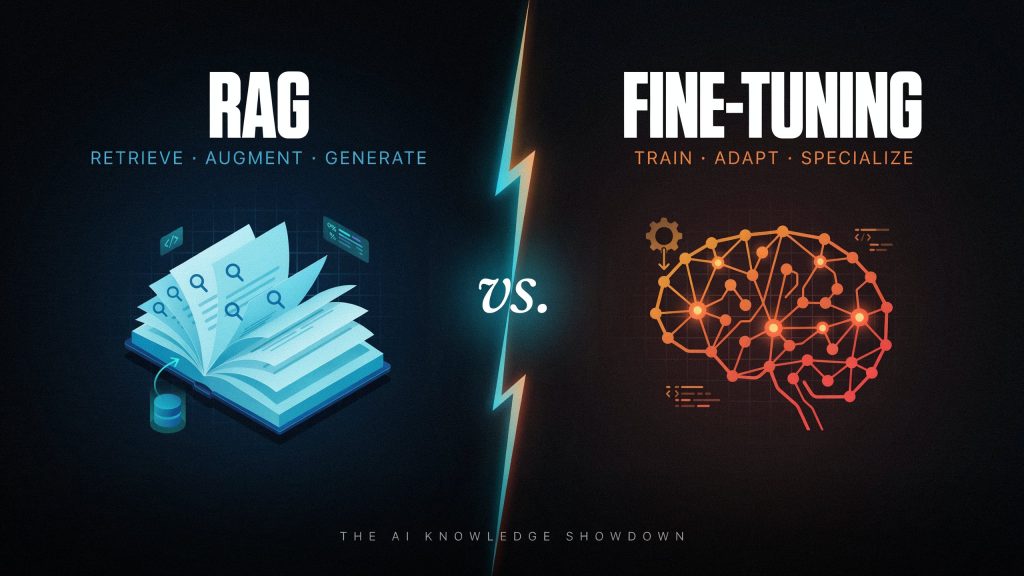
Two approaches dominate the conversation for solving this problem. Retrieval-augmented generation and fine-tuning. Both can make a large language model significantly more useful for your specific context. But they work in fundamentally different ways, suit different problems, and carry very different cost, complexity, and maintenance profiles.
The RAG vs. fine-tuning comparison is not a question of which technique is better in the abstract. Determining the right approach to RAG development services depends on your specific use case, data environment, and operational requirements. This blog explains both approaches clearly, maps out when to use fine-tuning vs. RAG, walks through a RAG vs. fine-tuning in plain language, and helps you make a mindful decision.
What Is Retrieval-Augmented Generation (RAG)?
Retrieval-augmented generation is an architecture that connects a language model to an external knowledge source. When a user asks a question, the RAG system first searches its connected knowledge base for relevant documents. Estimated at USD 1.2 billion, the RAG market is projected to reach USD 11.0 billion by 2030. It then offers both the original question and the retrieved information to the LLM and asks the question needed.
Think of it as giving the model a highly relevant reference document before it answers. It simply has access to new, current, relevant information at the point of generating a response.
The knowledge base can be anything: internal documentation, regulatory guidelines, support ticket histories, research papers, or proprietary databases. When that information is stored in a vector database, the model can surface relevant content when the user’s query phrasing doesn’t match.
What Is Fine-Tuning?
Fine-tuning takes a different approach entirely. Rather than connecting the model to an external source at runtime, fine-tuning modifies the model itself. It adjusts its internal parameters by training it on a curated, domain-specific dataset.
A fine-tuned model typically outperforms its corresponding base model when applying its training with domain-specific data. The fine-tuned LLM has a better understanding of the specific domain and its terminology.
Fine-tuning is powerful when the goal is to change how the model behaves. This includes the tone it uses, the format it produces, and the reasoning patterns it follows. A legal AI that needs to produce structured contract summaries in a specific format or a service model.
Key Differences in the RAG vs. Fine-Tuning Comparison
Understanding the RAG vs. fine-tuning comparison makes the decision significantly clearer.
| Feature | Retrieval-Augmented Generation (RAG) | Fine-Tuning |
| Knowledge Source | External knowledge base | Model training data |
| Information Updates | Real-time | Requires retraining |
| Model Training | Not Required | Required |
| Development Cost | Lower | Higher |
| Implementation Speed | Faster | Slower |
| Maintenance | Easier | More Complex |
| Best For | Dynamic and frequently changing information | Specialized knowledge and behaviour |
| Scalability | High | Moderate |
| AI Hallucination Risk | Lower | Depends on training quality |
Data freshness
If your knowledge changes frequently, RAG wins by a wide margin. A fine-tuned model is frozen at the point of its last training run. If your product catalogue changes monthly, your regulatory guidance updates quarterly. Or your internal policies evolve, that information must be manually incorporated through retraining. RAG handles this by updating the knowledge base and the model’s responses at the next query.
Cost profile
RAG adds recurring costs from context and retrieval, while fine-tuning shifts cost upfront with stable per-query pricing. RAG has lower upfront investment but higher ongoing operational costs because each query involves a retrieval step that consumes compute. Fine-tuning requires significant upfront investment in data preparation and model hosting, but per-query costs are typically lower once deployed.
Traceability and auditability
RAG wins decisively here. Because responses are grounded in specific retrieved documents, the system can cite sources. Users can check the provenance of any claim. RAG systems can cite their sources, so users can verify the information and trust the AI’s answers. Fine-tuned models offer no equivalent mechanism; they answer from internalised knowledge without pointing to a specific source.
Style customisation
Fine-tuning wins here. If you need the model to consistently produce responses in a specific format and use precise domain terminology. It follows particular reasoning patterns or communicates in a defined tone, fine-tuning is more effective than RAG. RAG changes what the model knows at query time, not how it thinks or communicates.
Security and data governance
Sensitive enterprise data can stay in a secure knowledge base and is only accessed at query time, not used to train a third-party model. For an AI integration company with strict data governance requirements, RAG keeps sensitive information in an access-governed database. Rather than embedding it into a model that may be hosted externally.
Implementation complexity
Both approaches require technical investment, but of different kinds. RAG requires building a pipeline for document ingestion, embedding, vector database management, and search quality tuning. Fine-tuning requires curating high-quality training data, managing training infrastructure, and maintaining the model. Hybrid requires both ML and data engineering capabilities simultaneously, a combination few organisations have.
How Does RAG Work?
Businesses prefer Retrieval-Augmented Generation for its ability to combine real-time information retrieval with language generation capabilities. RAG allows the model to retrieve relevant knowledge whenever a user asks a question.
Step 1: User Submits a Query
Everything begins when a user asks a question or submits a request. It could be a customer asking about a product, or an employee searching for company policies.
Step 2: The Retriever Searches the Knowledge Base
Instead of generating a response, the AI searches connected knowledge sources. Such as document repositories, vector databases, internal documentation, or enterprise CMSs. The retriever identifies the documents or data most relevant to the user’s query.
Step 3: Relevant Information is Retrieved
Once the search is complete, the system gathers the most relevant information as context for the language model. It ensures the AI works with current, business-specific information rather than relying on what it learned during training.
Step 4: The Language Model Generates the Response
The retrieved information is then passed to the large language model (LLM). It combines the external knowledge with its NLP capabilities to generate a context-aware response.
Step 5: The User Receives an Accurate Answer
Finally, the AI development company delivers a response that reflects the latest available information. Because the knowledge comes directly from trusted business sources, the chances of outdated responses are reduced.
RAG vs. Fine-Tuning Diagram
The following simplified workflow illustrates how a typical RAG architecture functions.
User Query
│
▼
Retriever Engine
│
▼
Enterprise Knowledge Base
(Documents, PDFs, CRM, ERP,
Websites, Databases, APIs)
│
▼
Retrieved Relevant Context
│
▼
Large Language Model (LLM)
│
▼
Accurate AI Response
How Does Fine-Tuning Work?
Unlike RAG, Fine-Tuning improves the AI model by teaching it new knowledge or domain-specific expertise.
Step 1: Collect High-Quality Training Data
The process begins with gathering a carefully curated dataset relevant to the intended use case. This data may include customer conversations, technical manuals, medical records, legal documents, or brand-specific content. The quality and relevance of this dataset directly influence the model’s performance.
Step 2: Prepare and Clean the Data
Before training begins, the collected data must be cleaned, organized, and formatted correctly. Duplicate entries, outdated information, and inconsistencies are removed to ensure the model learns from reliable examples.
Step 3: Train the Model
During this stage, the model adjusts its internal parameters to understand industry terminology, business workflows, or specialized tasks. Hire Agentic AI developers to generate more relevant and context-aware outputs.
Step 4: Validate and Test Performance
Once training is complete, the model undergoes extensive testing to evaluate its accuracy and to handle real-world scenarios. Developers measure performance against predefined benchmarks and refine the model if necessary.
Step 5: Deploy and Monitor the Model
After successful validation, the fine-tuned model is deployed into production. With change, firms must continuously monitor performance and periodically retrain the model with updated datasets.
When to Use Fine-Tuning vs RAG: A Practical Decision Guide
The most practical framing of when to use fine-tuning vs. RAG is to think in terms of what your use case actually requires.
Choose RAG when:
Your knowledge base changes frequently and keeping the model current matters. Use RAG when it’s important for generative AI responses to provide up-to-date information in LLM training. This covers most enterprise scenarios involving internal documentation, product information, policy libraries, and customer data.
You need users to be able to verify the model’s responses. In regulated industries financial services, healthcare, legal it is not a nice-to-have; it is a compliance requirement. RAG makes this possible. Fine-tuning does not.
Choose fine-tuning when:
Your use case requires consistent, specialised output formats or reasoning patterns that a base model does not naturally produce. Structured clinical documentation, legal contract drafting, standardised code review outputs from fine-tuning because you are shaping behaviour.
You are working with domain terminology that a general model handles poorly. Medical, legal, engineering, and financial domains all have vocabulary and conceptual frameworks that differ from general language.
Your knowledge base is stable.
When to Use Both: The Hybrid Approach
The RAG vs. fine-tuning comparison is often framed as a binary choice, but RAG and fine-tuning can be used together. While fine-tuning trains the model to understand specific tasks, RAG ensures the model has access to the most relevant data. Combining both methods can enhance the performance and reliability of the model.
A hybrid approach with fine-tuning the model, then deploying it with a RAG architecture to access current knowledge delivers both. The model understands your domain deeply and communicates in your preferred style.
Conclusion:
Rather than approaching the RAG vs. fine-tuning comparison as a technology preference, treat it as a requirements-matching exercise.
Start by asking what the core problem is. If it is that the model does not know your organisation’s current information, RAG addresses this directly. If it is that the model does not behave or communicate the way your use case requires, fine-tuning addresses this. Choosing the right approach depends on data volatility, query volume, and team capabilities.
FAQs
-
Should I choose RAG or fine-tuning for my business AI application?
The right choice depends on your use case. RAG is ideal for applications that require access to frequently updated information, while fine-tuning is better for tasks that need consistent behavior, domain expertise, or specialized language generation.
-
What is the main difference between RAG and fine-tuning?
RAG retrieves relevant information from external knowledge sources in real time before generating responses, whereas fine-tuning permanently trains an AI model on specific datasets to improve its performance for specialized tasks.
-
Is RAG more cost-effective than fine-tuning?
In many cases, yes. RAG often has lower upfront costs because it doesn’t require retraining the model whenever information changes. Fine-tuning may involve higher development and maintenance costs but can deliver better performance for specialized use cases.
-
Can RAG and fine-tuning be used together?
Yes. Many organizations combine RAG and fine-tuning to create AI applications that leverage real-time business data while benefiting from a model optimized for specific industries, workflows, or customer interactions.
-
Which industries benefit most from RAG and fine-tuning?
Industries such as healthcare, banking, legal, retail, manufacturing, customer support, and enterprise knowledge management benefit significantly. The best approach depends on whether the application requires real-time information retrieval, specialized expertise, or a combination of both.