If you have used a virtual assistant, watched a self-driving car navigate traffic, or seen an AI system play chess at a grandmaster level, you have already seen an intelligent agent in action.
An intelligent agent is one of the most fundamental concepts in artificial intelligence. It forms the backbone of how AI systems are designed to perceive, reason, and act.
Whether you are a student, developer, or someone trying to understand how modern AI actually works, knowing what an intelligent agent is gives you a clearer picture of the entire field.
This guide breaks down the concept from the ground up. Here we will cover what intelligent agents are, how they are structured, the different types, and where they show up in the real world.
What the Data Says About AI Agents in 2026
The growth of AI agents is happening at scale. Here are the latest figures from credible research firms and surveys:
- The global AI agents market was valued at around $5.4 billion in 2024 and is projected to reach $52.6 billion by 2030, growing at a CAGR of 46.3% (MarketsandMarkets, 2025)
- A Google Cloud study found 52% of enterprises had AI agents deployed in production during 2025
- According to a 2025 MIT SMR and BCG survey, 35% of organizations had adopted AI agents by 2023 and an additional 44% planned to follow suit shortly after.
- At least 15% of routine workplace decisions will be made autonomously by agentic systems by 2028, up from near zero in 2024 (Gartner)
- Over $9.7 billion has been invested in agentic AI startups since 2023
- A KPMG survey found 99% of organizations plan to eventually deploy agentic AI, though only 11% had reached that stage by mid-2025
What is an Intelligent Agent in AI?
An intelligent agent is any system that perceives its environment through sensors, processes the information it receives, and takes actions to achieve a specific goal.
The term comes from the foundational work of Stuart Russell and Peter Norvig in their textbook Artificial Intelligence: A Modern Approach, which defines an agent as anything that can be seen as perceiving its environment and acting upon it.
The word “intelligent” is added when your AI agent development does not just react blindly but uses reasoning, learning, or planning to decide what action to take.
A simple way to think about it: an intelligent agent takes inputs, processes them, and produces outputs in the form of actions. This is called the perception-action cycle.
Three core elements define every intelligent agent:
- Perception – The agent receives information from its environment through sensors (cameras, microphones, data feeds, text input).
- Processing – The agent uses an internal decision-making mechanism to determine the best course of action.
- Action – The agent acts on the environment through actuators (motors, text output, API calls, code execution).
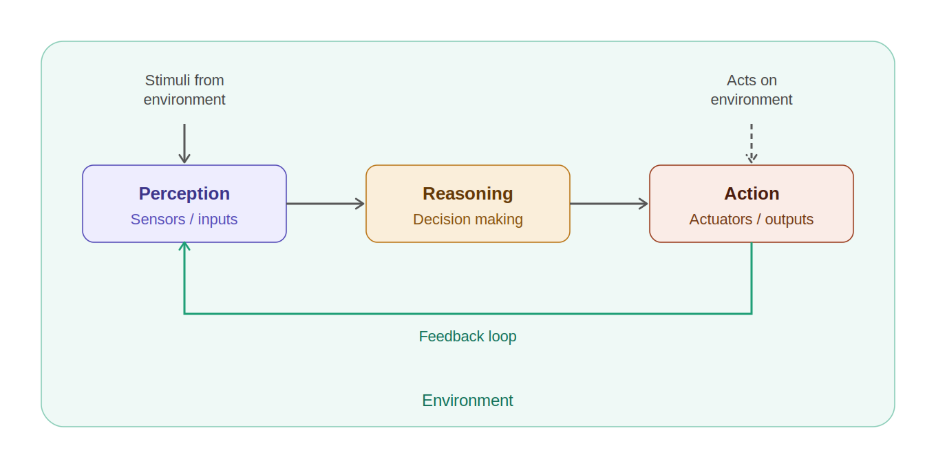
The environment can be physical (a room a robot navigates), digital (a website an AI browses), or abstract (a chess board).
How AI Engineers Design Intelligent Agents: The PEAS Framework
To define an intelligent agent properly, researchers use the PEAS framework. PEAS stands for:
- P – Performance Measure (how success is defined)
- E – Environment (where the agent operates)
- A – Actuators (how the agent takes action)
- S – Sensors (how the agent perceives the world)
For example, a self-driving car agent can be described using PEAS as:
- Performance: Safe arrival, fuel efficiency, legal compliance
- Environment: Roads, traffic, weather, pedestrians
- Actuators: Steering wheel, brakes, accelerator, signals
- Sensors: Cameras, LiDAR, GPS, radar, speedometer
This framework is used by AI engineers to formally design and evaluate agent-based systems before building them.
6 Core Properties That Define an Intelligent Agent
Not every software program qualifies as an intelligent agent. Researchers identify specific properties that distinguish an intelligent agent from a regular program:
-
Autonomy
It means the agent operates without constant human intervention. It makes decisions on its own based on its internal state and the information it perceives.
-
Reactivity
This means the agent responds to changes in its environment in real time. If the environment changes, the agent adjusts its behavior.
-
Proactivity
By proactivity we means the agent does not just react to the world but takes initiative to achieve its goals. It plans ahead and acts even when not directly prompted.
-
Social abilit
It means the agent can interact and communicate with other agents or humans. This is critical in multi-agent systems where multiple agents work together or compete.
-
Rationality
This means the agent selects actions that are expected to maximize its performance measure given its current knowledge and perceptions.
-
Learning ability
This (in advanced agents) means the agent improves its performance over time based on experience and feedback.
Different Types of Intelligent Agents in AI
Intelligent agents are classified based on how they make decisions. Russell and Norvig describe five main types, each more capable than the last.
-
Simple Reflex Agent
A simple reflex agent acts only on the current input. It uses condition-action rules: if the sensor detects X, perform action Y. There is no memory of past states.
A thermostat is a classic example. If the temperature drops below a set threshold, it turns on the heater. It does not consider what happened yesterday or predict what will happen tomorrow.
Limitation: These agents fail in partially observable environments where current input alone is not enough to make a good decision.
-
Model-Based Reflex Agent
This agent maintains an internal model of the world. It keeps track of parts of the environment it cannot currently observe and uses that model to make decisions.
A robot navigating a building stores a map of rooms it has already explored. Even if it cannot currently see a room, it remembers it exists and can plan routes through it.
-
Goal-Based Agent
A goal-based agent knows what goals it wants to achieve and chooses actions that move it toward those goals. It goes beyond simple condition-action rules by considering the future outcomes of its actions.
A GPS navigation system is a goal-based agent. Its goal is to get you from point A to point B. It evaluates multiple possible routes and selects the one that best achieves that goal under current conditions.
-
Utility-Based Agent
A utility-based agent does not just aim for a goal but tries to maximize a utility function, which measures how desirable a particular state is. This is important when multiple actions could achieve a goal but with different levels of quality.
A chess-playing AI does not just try to win. It evaluates positions based on a utility score and tries to reach the state with the highest utility. This is why it can sacrifice a piece strategically to gain a better position later.
-
Learning Agent
A learning agent improves its performance over time. It uses feedback from its past actions to update its knowledge and decision-making process. Most modern AI systems, including large language models and reinforcement learning agents, fall into this category.
A learning agent has four components: a learning element that improves behavior, a performance element that selects actions, a critic that evaluates performance, and a problem generator that suggests new experiences.
How Multi-Agent Systems Are Structured
A multi-agent system development (MAS) is a network of multiple intelligent agents that interact with each other within a shared environment. Each agent has its own perception and decision-making, but agents influence each other through their actions.
Multi-agent systems can be:
Cooperative, where agents work together toward a shared goal (swarm robotics, distributed logistics).
Competitive, where agents compete for resources or goals (auction systems, game-playing AI).
Mixed, where agents are partly cooperative and partly competitive (financial markets, traffic management).
Multi-agent systems are used in supply chain management, autonomous vehicle coordination, financial trading, and large-scale simulations. They are also central to recent research in AI alignment and AI safety, where multiple AI agents must behave predictably when they interact.
5 Real-World Examples of Intelligent Agents
Understanding intelligent agents becomes much clearer with concrete examples across different domains.
-
Virtual Assistant
Siri, Alexa, and Google Assistant are language-based intelligent agents. They perceive voice input, process it using natural language understanding, and take actions like setting reminders, answering questions, or controlling smart home devices.
-
Large Language Models (LLMs)
GPT-5 and Claude are intelligent agents when paired with tools. On their own, LLMs generate text. When connected to web search, code execution, or file management tools, they become agents that perceive a task, reason about it, and take multi-step actions to complete it.
-
Robotic Process Automation (RPA
By RPA, tools are software agents that automate repetitive digital tasks. They perceive screen content, process instructions, and take actions like clicking buttons, filling forms, and extracting data.
-
Game-Playing AI
Systems like AlphaGo, AlphaStar, and OpenAI Five are utility-based learning agents. They perceive the game state, use deep neural networks and reinforcement learning to evaluate actions, and take moves that maximize their probability of winning.
-
Autonomous Vehicles
These combine multiple agent types. Perception systems handle sensors, planning systems handle route decisions, and control systems handle physical actions. Together, they form a complex agent operating in a dynamic, partially observable environment.
-
AI Trading System
In financial markets, these are goal-based and utility-based agents that perceive market data, process patterns, and execute trades to maximize returns while managing risk.
A Real Case Study of Intelligent Agents in Action
We built an agentic AI layer for an EdTech client whose learning platform was entirely static. Learners had no real-time support, search had no context awareness, and progress tracking was manual.
The solution used LLMs, session memory, semantic search with vector embeddings, and a real-time tracking pipeline that adjusted content difficulty and learning paths automatically based on learner behavior.
Results: 30% improvement in course completion, 60 to 70% of learner queries handled automatically, and 2.5x more active learners supported without adding headcount.
Difference Between Rational Agents and Optimal Agents
A common question is whether an intelligent agent must always make the perfect decision. The answer is no.
A rational agent does the best it can given its current knowledge and computational resources. It does not require complete knowledge of the environment or unlimited time to compute.
An optimal agent would always find the best possible action, but this is often computationally impossible in complex, real-world environments.
This distinction matters in practice. In robotics, a rational agent moves efficiently with available sensors. In medical diagnosis AI, a rational agent makes the best recommendation given available patient data, not the theoretically perfect recommendation based on complete knowledge.
Difference Between Intelligent Agents and Agentic AI
Recent AI developments services have made the concept of intelligent agents more relevant than ever. Agentic AI refers to AI systems that can autonomously plan and execute multi-step tasks with minimal human oversight.
Modern agentic AI systems like AutoGPT, Claude with tools, and similar frameworks use large language models as the reasoning core of an agent. They are given access to tools (web search, code execution, file management, APIs) and operate in a loop: observe the task, plan steps, take an action, observe the result, and continue until the goal is achieved.
This architecture is directly rooted in the intelligent agent framework. The LLM acts as the agent’s brain. The tools act as actuators. The outputs of those tools feed back as new perceptions.
The shift toward agentic AI is significant because it moves AI from a passive question-answering tool to an active system that completes complex workflows autonomously.
5 Key Challenges in Building Intelligent Agents
Building effective intelligent agents involves solving several hard problems:
-
Partial observability
This is one of the most common challenges. Most real environments do not give an agent complete information. A robot in a building cannot see every room at once. A trading agent cannot see every market participant’s intentions.
-
Uncertainty
Uncertainty is present in almost every real-world environment. Sensors are noisy, predictions are probabilistic, and actions do not always produce expected results. Intelligent agents must handle uncertainty through probabilistic reasoning.
-
Credit assignment
This is the problem of figuring out which past actions contributed to a current reward or failure. This is especially hard in long sequences of actions, which is a major challenge in reinforcement learning.
-
Scalability
Scalability is also a challenge in multi-agent systems. As the number of agents increases, the interactions between them grow exponentially, making coordination and prediction difficult.
-
Safety and alignment
These are increasingly important concerns. As intelligent agents become more autonomous, ensuring they act in ways aligned with human values and goals is a critical research area.
Conclusion
An intelligent agent in AI is a system that perceives its environment, processes information, and acts to achieve defined goals. From simple thermostats to complex agentic AI development, the core architecture remains consistent: input, reasoning, output.
The five main types, including simple reflex, model-based, goal-based, utility-based, and learning agents, represent a spectrum of capability and complexity. Modern AI development is increasingly built around this framework, with agentic AI systems now handling tasks that previously required sustained human effort.
Understanding intelligent agents gives you a solid conceptual foundation not just for AI theory but for understanding where the field is heading practically, from autonomous robots and self-driving cars to AI agents that manage entire digital workflows on behalf of users.
FAQs
Q1. Is every AI chatbot an intelligent agent?
Not exactly. A basic chatbot that follows a fixed script and responds only to preset inputs is not an intelligent agent. It has no perception-action loop and no ability to adapt. However, when an AI chatbot solution is connected to tools and the ability to take actions like searching the web or booking a calendar slot, it starts functioning as an intelligent agent. The distinction lies in whether the system can perceive, reason, and act autonomously toward a goal.
Q2. Do intelligent agents always make the right decision?
No, and they are not designed to. Intelligent agents are built to be rational, meaning they make the best decision possible given the information available to them at that moment. They are not optimal, which would require perfect knowledge and unlimited computing power. In practice, agents work with incomplete data, noisy sensors, and computational limits. Mistakes happen, which is why testing, monitoring, and human oversight remain important even in highly autonomous systems.
Q3. Are intelligent agents safe to use in business without human supervision?
It depends on the task and the stakes involved. For low-risk, well-defined tasks like data extraction or report formatting, agents can operate with minimal oversight and perform reliably. For higher-stakes tasks involving financial decisions, customer communications, or anything with legal consequences, human review remains important. The honest answer is that agentic AI is still maturing. Most enterprise deployments today use a human-in-the-loop model where the agent handles execution but a person reviews or approves critical actions.