If you’ve followed the trajectory of artificial intelligence, you’ve witnessed a revolution. From the stunning conversational abilities of ChatGPT to the breath-taking power of image generators, we’ve grown accustomed to interacting with a single and powerful intelligence in a box. We give it a prompt, and it gives us an answer.
But what happens when the question is too big for one box? What happens when the task is too complex for a single AI, no matter how powerful?
This is the frontier where the true future of AI is being built and it’s where a critical and often overlooked distinction becomes paramount: the difference between an AI Agent and Agentic AI.
These terms are frequently used interchangeably. This creates a fog of confusion around one of the most significant advancements in the field. Is it just marketing jargon, or is there a fundamental technological shift at play?
According to PwC’s AI Agent Survey, 35% of companies using AI agents say they’re doing so broadly, and 17% say adoption is nearly complete across all workflows.
Understanding the difference between AI Agent vs Agentic AI is key to foreseeing how AI will integrate into our businesses, our workflows, and our world. It’s the difference between hiring a brilliant, multi-talented individual and building a world-class, cross-functional organization.
We have already covered “Agentic AI vs Gen AI” and “Agentic AI vs Traditional AI” in our other articles.
In this article, you will not only understand the technical distinctions but, more importantly, you will grasp why this evolution from AI agent to Agentic AI is what will ultimately solve the world’s most complex challenges.
Let’s begin.
What is an AI Agent?
If we are to understand the orchestra, we must first appreciate the skill of the individual musician. An AI Agent is precisely that: a specialized, autonomous entity designed to perform a specific task or set of tasks from start to finish.
AI agent is the fundamental unit of automation which is capable of playing a complex piece on its own.
But what exactly transforms a standard AI model into an active agent? The distinction lies in a shift from passive intelligence to active execution. A traditional AI like a chatbot can answer a question. But an AI Agent can take that answer and do something with it.
The Core Mechanics of AI Agent: The P.E.A.S. Framework
We can best understand any AI Agent by breaking it down using the classic P.E.A.S. framework, which stands for Performance, Environment, Actuators, and Sensors. An AI Agent continuously loops through this cycle:
Performance Measure: It is the objective or success criteria for which the agent is designed to optimize. This is its primary goal, such as maximizing trading profits, ensuring data accuracy, or completing a task within a set time.
Environment: This is the “stage” on which the agent operates. It could be digital (a database, a software interface) or physical (a room, a warehouse). The complexity of the environment dictates the complexity of the agent.
Actuators: They are the tools it uses to affect its environment. In the digital realm, this could be an API call, a function call, or a command to write to a file. In the physical world, it could be a motor, a lever, or a speaker.
Sensors: They are how the agent perceives the state of its environment. This could be a user prompt, data from a sensor, a stream of market data, or the contents of a file.
Strengths and Limitations of An AI Agent
The power of an AI Agent development solution is its focus and efficiency. For a well-defined, bounded task, a specialized agent is often the fastest, most reliable, and most cost-effective solution. It embodies the principle of “do one thing and do it well.”
However, this strength is also its primary weakness. The AI agent, no matter how brilliant, has inherent limitations:
The “Jack of All Trades” Problem: A single agent struggles with problems that require deep expertise. You wouldn’t ask a violinist to fix a broken trumpet.
Limited Perspective: It lacks the ability to self-critique or see the “big picture.” Its work is only as good as its initial programming and model weights.
The Brittleness Problem: If a task requires a skill outside its core competency or the environment changes unexpectedly, the agent can easily get “stuck” or fail without a clear path to recovery. This is simply because AI agents cannot fundamentally reconfigure their own capabilities.
What is Agentic AI?
If an AI Agent is a skilled soloist, then Agentic AI is the entire orchestra. It is not a single entity, but a sophisticated system of multiple and collaborative AI agents working in concert, guided by an overarching process, to solve problems that are far too complex for any single agent to handle.
The core of Agentic AI lies in a fundamental architectural shift from autonomy to orchestration. It moves beyond the question of “What can one agent do?” to “What can a team of specialized agents achieve when working together?”
The Pillars of Agentic AI
As a leading Agentic AI development company, we build our custom systems on several key principles that enable this collaborative intelligence:
Multi Agent Collaboration: This means instead of one monolithic agent, multiple specialized agents are deployed. Each has a distinct role.
Specialization and Role-Playing: Agents are assigned specific functions based on their strengths. A common pattern involves roles like a Researcher to gather data, an Analyst to interpret information, a Writer to draft content, and a Critic to review and refine the output. This division of labor dramatically increases the quality and depth of the final result.
Orchestration and Workflow: This is a defined workflow which can be managed by a dedicated “manager” agent or a pre-programmed process. This agent or process breaks down a high-level goal into sub-tasks.
In simple words, it assigns them to the appropriate specialized agents and synthesizes their contributions into a cohesive whole.
Iterative Refinement: Agentic AI systems are built for loops of feedback and improvement. The Critic agent can review the Writer’s draft. Then it provides feedback. And the Writer can then produce an improved version. This emergent behavior leads to higher-quality outcomes than a single pass could ever achieve.
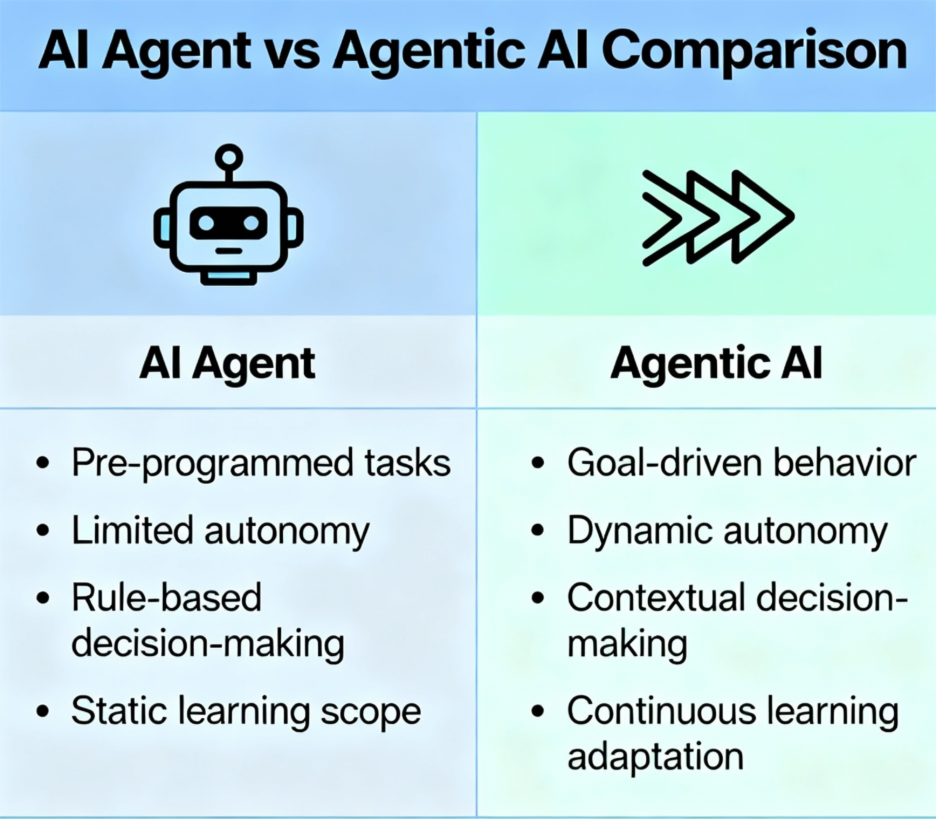
AI Agent vs Agentic AI: A Quick Comparison
This table provides a scannable reference for Agentic AI vs AI agent.
| Feature | AI Agent | Agentic AI |
| Core Definition | A single, autonomous system that performs tasks. | A paradigm or framework where multiple AI agents collaborate. |
| Primary Analogy | A skilled employee or a specialist. | An entire company or an orchestrated team. |
| System Architecture | Monolithic; a single entity working alone. | Multi-agent; a system of interconnected, specialized entities. |
| Primary Goal | To complete a specific, bounded task efficiently. | To solve a complex, multi-faceted problem by dividing labor. |
| Key Strength | Autonomy, speed, and reliability for defined tasks. | Collaboration, specialization, and emergent problem-solving. |
| Complexity Handled | Low to medium complexity; linear, well-defined tasks. | High to extreme complexity; non-linear, multi-step projects. |
| Decision-Making | Makes decisions internally to achieve its own goal. | Involves coordinated decision-making across agents, often with an orchestrator. |
| Workflow | Follows a pre-defined or learned action loop. | Follows a dynamic workflow with task decomposition and iterative refinement. |
| Example Task | “Book a flight to New York.” | “Plan and execute our entire Q4 marketing campaign.” |
| Common Frameworks | Often built with single-agent tools (e.g., LangChain tools). | Built with multi-agent frameworks (e.g., CrewAI, AutoGPT, LangGraph). |
Why Agentic AI vs AI Agents Difference is Important: Implications for the Future
What we believe is that AI agent vs Agentic AI is an important concept to know of. It has practical implications for how businesses invest in technology and how society prepares for the next wave of automation.
This is precisely why a new class of specialized Agentic AI development companies is emerging, focusing solely on building these complex systems.
-
For Businesses and Strategic Investment
The choice between deploying a single agent and investing in an Agentic AI framework hinge on the nature of the problem you need to solve.
AI Agent Use Cases:
You can implement a single AI Agent for targeted, repetitive, and well-defined tasks. This is a perfect choice for achieving rapid efficiency gains in specific areas, such as:
- Automating customer service ticket routing and basic queries.
- Deploying a single bot for data entry and validation.
- Using an agent to monitor IT infrastructure and trigger alerts.
Agentic AI Use Cases:
You can invest in Agentic AI development when the goal is to transform entire business processes or tackle open-ended, strategic challenges. This is the realm of:
- End-to-end software development lifecycle management.
- Autonomous scientific research and discovery across multiple data sources.
- Holistic digital marketing campaign management, from strategy to execution and analysis.
- Enterprise-level supply chain optimization that dynamically adjusts to disruptions.
- For Developers and Technologists
The shift from single agents to Agentic AI represents a fundamental change in the developer’s role.
The Old Focus: Building a “smarter” single agent by fine-tuning a model or expanding its toolset.
The New Frontier: Designing intelligent Agentic AI architecture. The premium skill is shifting from model training to orchestration engineering.
This means designing workflows, communication protocols, and feedback loops that enable multiple agents to collaborate effectively. The rise of frameworks like CrewAI and LangGraph is a direct response to this new need.
-
For Society and the Future of Work
The societal impact of Agentic AI will be significantly broader than that of single AI Agents.
A single agent automates a task and an Agentic AI system has the potential to automate an entire job function or business unit.
Let me just tell you that this doesn’t merely encourage human workers. What this does is create a new collaborative dynamic where humans act as supervisors, strategists, and ethical overseers for teams of AI agents.
Conclusion
The journey from the concept of a single AI Agent to the paradigm of Agentic AI represents a major change in how we conceptualize artificial intelligence’s role in solving complex problems.
We’ve seen that AI Agents and Agentic AI represent two different approaches to artificial intelligence. One is a specialist that works alone, while the other is a team that works together.
AI Agents are great at handling specific tasks quickly and efficiently. But they have limits. When a job becomes too complex or requires different types of expertise, a single agent can struggle.
Agentic AI brings together multiple AI agents, each with their own specialty, to handle complex projects.
Looking ahead, the most powerful applications of AI won’t come from single super-smart systems, but from groups of AI agents working together effectively.
FAQs
Q1: Is Agentic AI just a fancy way of saying “multiple AIs”?
In a way, yes. But the key is how they work together. It’s not just having multiple AIs. Agentic AI has a structured system where they collaborate, specialize in different roles, and refine each other’s work.
Q2: Is Agentic AI available right now, or is it just a theory?
It’s available now. But it’s in its early stages. Developers and companies are actively using frameworks like CrewAI and AutoGPT to build these systems. However, it’s not yet a perfectly reliable, “set it and forget it” technology. Running it can be expensive. Plus, making the agents work together smoothly without errors is a major focus of current development.
Q3: What’s the biggest challenge with Agentic AI?
The main challenges are cost, control, and complexity. Running multiple advanced AI agents is computationally expensive. Furthermore, it is complex to manage their interactions. You need to make sure they don’t get stuck in loops and misinterpret each other.