Artificial Intelligence (AI) has transformed the way businesses use images and videos. Instead of simply capturing visual data through cameras, smartphones, drones, or sensors, organizations can now extract valuable insights that help them make smarter decisions. Whether it is identifying defective products, monitoring traffic flow in smart cities, or counting inventory in a warehouse, computer vision enables machines to understand visual information much like humans do but at a much larger scale and much faster speed.
As companies begin investing in computer vision development services, they often come across two commonly used technologies: object detection and image segmentation. Since both involve identifying objects within an image, many people assume they are interchangeable. However, these technologies are designed to solve different business challenges and provide different levels of visual understanding.
In this guide, we’ll explain the differences between object detection and image segmentation in simple terms. You’ll learn how each technology works, where businesses use them, their advantages and limitations, development costs, and how to determine which solution best aligns with your business goals.
What is Object Detection?
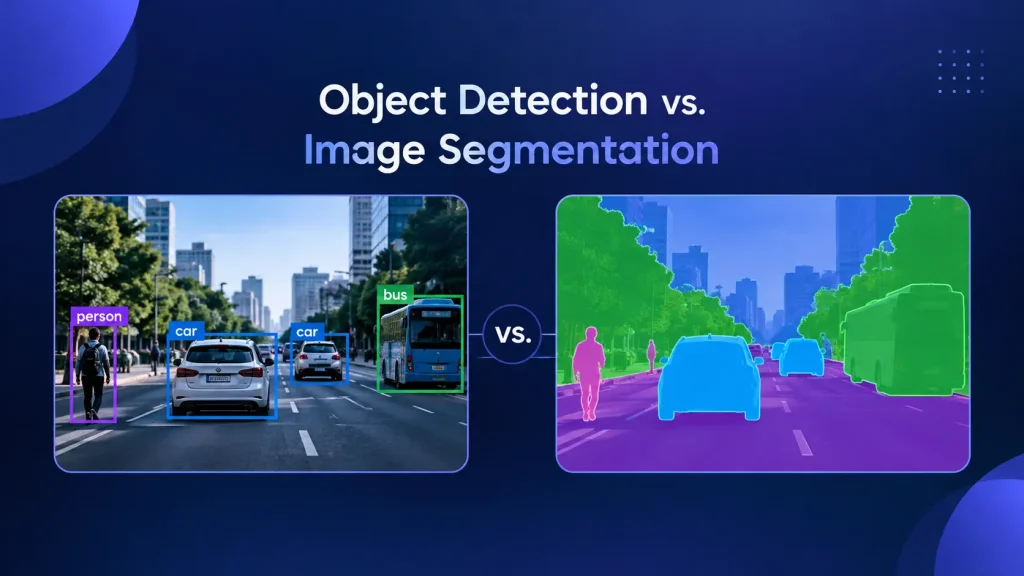
Object detection is a computer vision technique that enables Artificial Intelligence to identify, classify, and locate one or more objects within an image or video. Unlike traditional image recognition, which only determines what an image contains, object detection also identifies where each object is located by placing a rectangular bounding box around it.
Imagine you’re looking at a parking lot through a security camera. A simple image classification model may only tell you that the image contains vehicles. Object detection takes this a step further by identifying every individual car, motorcycle, truck, or person in the scene and marking their locations separately. This additional context allows businesses to automate tasks that would otherwise require constant human monitoring. The technology relies on deep learning models trained using millions of labeled images.
Common Business Applications of Object Detection
Object detection is used across industries where identifying and locating objects is enough to automate operations or improve decision-making. Some of its most common business applications include:
- Retail and eCommerce: Monitoring shelf inventory, detecting out-of-stock products, analyzing customer movement, and preventing theft.
- Manufacturing: Identifying defective products, monitoring production lines, counting finished goods, and ensuring workplace safety.
- Healthcare: Detecting medical equipment, monitoring patient movement, and assisting in identifying abnormalities in diagnostic images.
- Transportation and Logistics: Recognizing vehicles, tracking shipments, managing parking spaces, and improving traffic management.
- Agriculture: Counting crops, monitoring livestock, detecting pests, and analyzing farm productivity.
- Security and Surveillance: Detecting unauthorized access, recognizing suspicious objects, monitoring crowds, and improving public safety.
These applications demonstrate how object detection helps businesses automate repetitive tasks, improve operational visibility, and reduce dependence on manual monitoring.
What is Image Segmentation?
Image segmentation is an advanced computer vision technique that divides an image into multiple meaningful regions. Especially by assigning every single pixel to a specific object or background. Instead of simply identifying that an object exists, image segmentation precisely outlines its exact shape, size, and boundaries, allowing AI to understand the image in much greater detail.
To better understand the difference, imagine looking at a photograph of a tree. Object detection would place a rectangular box around the tree and identify it as a “tree.” Image segmentation, however, would carefully trace every branch, leaf, and visible part of the tree, separating it from the sky, ground, and surrounding objects. This pixel-level precision makes image segmentation particularly valuable when even small details can influence business decisions.
Types of Image Segmentation
Image segmentation is generally divided into three categories, depending on the level of detail required for an AI development company business application.
Semantic Segmentation
Semantic segmentation classifies every pixel in an image according to its category. All objects belonging to the same class receive the same label. For example, every car in an image would be identified as “car,” but individual cars would not be distinguished from one another.
This approach is commonly used in satellite imaging, land classification, environmental monitoring, and road scene analysis, where understanding categories is more important than identifying individual objects.
Instance Segmentation
Instance segmentation takes the process one step further by recognizing each object as a separate entity, even if multiple objects belong to the same category. This makes it highly valuable for warehouse automation, retail inventory tracking, manufacturing inspections, and robotics, where distinguishing between individual objects is essential.
Panoptic Segmentation
Panoptic segmentation combines the strengths of semantic and instance segmentation into a single model. It classifies every pixel while also identifying individual object instances wherever necessary.
This comprehensive understanding makes panoptic segmentation particularly useful in autonomous driving, smart city infrastructure, advanced robotics, and large-scale environmental analysis.
How Does Object Detection Work?
Although different AI models follow slightly different architectures, the overall workflow remains similar.
Step 1: Image Acquisition and Input
The process begins when the AI system receives an image or a video frame from a camera, smartphone, drone, CCTV system, medical scanner, or any other visual source.
This image becomes the input that the AI model needs to analyze. Depending on the business application, the input may be a single image captured every few minutes or a continuous stream of video processed in real time.
The quality of the input image plays a major role in detection accuracy. High-resolution images, proper lighting, and minimal visual obstructions help the AI identify objects more reliably.
Step 2: Feature Extraction
Once the image is received, the AI begins extracting important visual features.
Instead of looking at the entire image all at once, deep learning models identify meaningful patterns such as edges, textures, shapes, colors, corners, and contrasts. These features help the system distinguish one object from another.
Modern neural networks automatically learn these features during training without requiring developers to manually define them. As more training data is provided and you hire Agentic AI developers, the model becomes recognizing objects even when they appear in different positions, sizes, or lighting conditions.
Step 3: Object Localization
After identifying visual features, the AI determines where each object is located within the image.
To do this, it generates rectangular bounding boxes around every detected object. These boxes indicate the approximate position and size of each object while separating it from the surrounding environment.
This localization capability allows businesses to count them, monitor movement, measure distances, and analyze interactions between different objects.
In retail stores, localization helps monitor customer movement. In manufacturing, it identifies products moving through production lines. In logistics, it tracks packages throughout warehouse operations.
Step 4: Object Classification
Once an object has been located, the AI determines what the object actually is.
The system compares the extracted visual features against patterns learned during training and assigns the object to the most appropriate category.
For example, instead of simply detecting “an object,” the model classifies it as:
- Car
- Person
- Bicycle
- Dog
- Product
- Helmet
- Machine component
The number of categories depends entirely on how the model has been trained. Some business models recognize only a few object types, while enterprise solutions can identify hundreds or even thousands of categories.
Accurate classification enables businesses to automate decision-making without human intervention.
Step 5: Confidence Score Generation
Not every prediction made by AI is equally certain.
For this reason, object detection models assign a confidence score to every detected object. This score represents how confident the AI is that its prediction is correct.
For example:
- Person — 99% confidence
- Car — 96% confidence
- Bicycle — 88% confidence
Businesses can set confidence thresholds based on their requirements.
Confidence scoring helps reduce false detections and allows businesses to build AI systems that match their desired balance between speed and accuracy.
Popular Object Detection Models
Some of the most widely used object detection models include:
YOLO (You Only Look Once)
YOLO is one of the fastest object detection models available today. It processes an entire image in a single pass, making it ideal for real-time applications such as autonomous vehicles, surveillance systems, robotics, and traffic monitoring.
Businesses choose YOLO when they require quick decision-making without sacrificing too much accuracy.
Faster R-CNN
Faster R-CNN focuses on delivering high detection accuracy, even in complex environments where multiple objects overlap or appear at different scales.
Although it is slower than YOLO, it is commonly used in medical imaging, quality inspection, and research applications where precision is more important than speed.
SSD (Single Shot Detector)
SSD offers a balance between speed and accuracy.
It is frequently used in mobile applications, embedded systems, and edge AI devices because it delivers reliable performance while requiring fewer computational resources.
RetinaNet
RetinaNet was designed to improve the detection of smaller and less common objects that many earlier models struggled to recognize.
Businesses working with satellite imagery, defect detection, and security surveillance often benefit from RetinaNet’s improved accuracy for challenging visual tasks.
How Does Image Segmentation Work?
The overall workflow involves several stages.
Step 1: Image Input
Just like object detection, the process begins when an image enters the AI system.
The image may come from:
- Medical scanners
- Satellite imagery
- Manufacturing cameras
- Drones
- Autonomous vehicles
- Smartphones
Industrial inspection systems
The quality and consistency of these images directly influence segmentation accuracy.
Businesses often invest in high-quality imaging equipment because clearer images help AI produce more reliable segmentation results.
Step 2: Pixel-Level Analysis
This is where image segmentation becomes fundamentally different from object detection.
Instead of analyzing only important regions, the AI examines every pixel individually while considering its relationship with neighboring pixels.
The model determines whether each pixel belongs to:
- An object
- Another object
- The background
- This process continues until every pixel has been assigned a category.
Because millions of pixels may exist within a single image, segmentation models require substantially more computational resources than object detection systems.
Step 3: Object Boundary Identification
Once pixels have been classified, the AI identifies the exact boundaries surrounding each object. Rather than producing rectangular boxes, the model traces the natural shape of the object.
Similarly, in manufacturing, it identifies tiny scratches or cracks on a product’s surface that may be invisible using object detection alone.
This precise boundary identification enables businesses to measure dimensions, estimate volumes, detect abnormalities, and perform detailed quality inspections.
Step 4: Pixel Classification and Mask Generation
After determining the object’s boundaries, the AI generates segmentation masks.
A segmentation mask is a visual layer that assigns a unique label or color to every object or region within the image.
For example:
- Road → Gray
- Vehicle → Blue
- Person → Red
- Building → Yellow
- Vegetation → Green
These masks help both humans and Agentic AI development company understand complex scenes with remarkable clarity.
Businesses use segmentation masks to automate inspections, improve navigation systems, monitor environmental changes, and analyze medical conditions more accurately.
Step 5: Final Segmented Output
The final output provides a complete understanding of the image at the pixel level.
Unlike object detection, which only reports object locations, segmentation delivers detailed information about:
- Exact object shapes
- Object size
- Surface area
- Spatial relationships
- Pixel-level measurements
- Background separation
This information supports applications where even small visual differences can influence important business decisions.
Popular Image Segmentation Models
Several advanced deep learning models are commonly used for image segmentation.
U-Net
U-Net is one of the most widely used segmentation models in healthcare because it performs exceptionally well with medical images. It accurately identifies organs, tumors, and tissues even when training data is limited.
Mask R-CNN
Mask R-CNN combines object detection and image segmentation into a single model. It first detects objects and then generates a precise segmentation mask for each one.
This makes it ideal for manufacturing inspections, robotics, and retail analytics.
DeepLabV3+
DeepLabV3+ specializes in capturing fine object boundaries and complex image details.
Businesses use it in satellite imaging, environmental monitoring, agriculture, and infrastructure analysis where detailed scene understanding is essential.
SegFormer
SegFormer is a newer transformer-based segmentation model that delivers high accuracy while remaining computationally efficient.
Its scalability makes it suitable for enterprise AI applications requiring fast deployment across multiple industries.
Object Detection vs. Image Segmentation: Feature-by-Feature Comparison
| Feature | Object Detection | Image Segmentation |
| Primary Goal | Identifies what the object is and where it is located using bounding boxes. | Identifies every object while outlining its exact shape using pixel-level masks. |
| Output | Rectangular bounding boxes with labels. | Detailed segmentation masks covering every pixel. |
| Level of Detail | Moderate. Suitable when approximate location is sufficient. | Extremely detailed. Suitable for precision-based tasks. |
| Accuracy Requirements | High for object recognition and localization. | Very high because every pixel must be classified correctly. |
| Processing Speed | Faster, making it ideal for real-time applications. | Slower due to complex pixel-by-pixel analysis. |
| Computational Resources | Lower GPU and processing requirements. | Higher GPU memory and computational power needed. |
| Training Complexity | Easier and faster to train. | More complex because pixel-level annotations are required. |
| Dataset Annotation | Bounding boxes are relatively quick to create. | Pixel-level labeling is time-consuming and expensive. |
| Development Cost | Generally lower due to simpler implementation. | Higher because of advanced model training and detailed annotations. |
| Best Business Use Cases | Retail analytics, surveillance, inventory counting, logistics, and traffic management. | Medical imaging, quality inspection, autonomous vehicles, precision agriculture, and satellite analysis. |
Advantages of Object Detection
Below are some of its biggest business advantages.
Faster Image Processing
One of the biggest strengths of object detection is its ability to process images and videos quickly. Since the AI only needs to identify objects and place bounding boxes around them, it performs fewer calculations than image segmentation models.
This speed makes object detection ideal for businesses that rely on real-time decision-making.
Lower Development and Infrastructure Costs
Compared to image segmentation, object detection is generally more affordable to develop and deploy. Training datasets are easier to prepare because developers only need to label objects with bounding boxes instead of outlining every pixel.
The models also require less computational power, reducing GPU usage and cloud infrastructure costs. This makes object detection an attractive option for startups and small to medium-sized businesses that want to adopt multi-agent system development company without making a significant upfront investment.
Easier Model Training and Deployment
Training an object detection model is relatively straightforward because the annotation process is simpler and less time-consuming. Businesses can collect labeled datasets more quickly, enabling faster model development and deployment.
Additionally, many pre-trained object detection models are available, allowing organizations to fine-tune existing models instead of building AI systems from scratch.
Excellent for Real-Time Applications
Many industries require AI systems to make decisions instantly. Object detection is designed to meet these real-time performance requirements.
For example:
- Autonomous delivery robots need to recognize pedestrians and obstacles while moving.
- Manufacturing systems must detect defective products before they continue down the production line.
- Retail stores use AI-powered cameras to monitor customer activity and prevent theft in real time.
- Because object detection balances speed with high accuracy, it supports business operations where delays could reduce productivity, increase costs, or compromise safety.
Highly Scalable Across Industries
Another major advantage is scalability. Once trained, object detection models can process large volumes of images and videos with minimal manual intervention.
Organizations can integrate the technology into multiple departments, including manufacturing, logistics, healthcare, agriculture, retail, and security.
As businesses grow, the same AI system can often be expanded to monitor additional facilities, production lines, or camera networks without requiring major changes to the underlying model.
Advantages of Image Segmentation
Although image segmentation requires greater computational resources, makes it invaluable in industries where accuracy influences business outcomes.
Pixel-Level Precision
The biggest advantage of image segmentation is its ability to understand images at the pixel level. Instead of simply identifying that an object exists, it determines its exact shape, boundaries, and size.
This level of detail helps businesses perform highly accurate visual analysis.
Pixel-level precision significantly improves the quality of AI-generated insights, reducing the chances of missed defects or incorrect measurements.
Improved Measurement Accuracy
Many industries require precise measurements rather than approximate object locations. Image segmentation enables businesses to calculate an object’s dimensions, surface area, and volume with remarkable accuracy.
For example, construction companies can measure structural damage after natural disasters, while agricultural businesses can estimate crop coverage across large farms using drone imagery.
Better Defect Detection and Quality Control
Image segmentation is particularly valuable for manufacturing because it can detect extremely small defects that may be overlooked by object detection.
Instead of simply identifying a product, the AI analyzes its entire surface to locate cracks, scratches, dents, discoloration, or missing components.
This improves product quality, reduces customer complaints, minimizes recalls, and lowers production waste.
Superior Medical Image Analysis
Healthcare organizations rely heavily on image segmentation because medical decisions often require extremely detailed visual information.
Segmentation helps doctors identify tumors, blood vessels, organs, bones, and damaged tissues with greater accuracy than object detection.
It also supports treatment planning by enabling specialists to measure disease progression over time.
As AI adoption continues to grow in healthcare, image segmentation is becoming an essential tool for improving diagnostic accuracy and patient outcomes.
Enhanced Scene Understanding
Image segmentation provides AI with a much richer understanding of complex environments by identifying both individual objects and the surrounding background.
For autonomous vehicles, this means distinguishing roads, sidewalks, pedestrians, traffic signs, buildings, and obstacles simultaneously.
Similarly, smart city projects use segmentation to analyze urban infrastructure, monitor environmental changes, and improve public safety.
This comprehensive understanding enables businesses to develop intelligent systems capable of making more informed and reliable decisions.
Limitations of Object Detection
Understanding these limitations helps businesses determine object detection alone is sufficient.
Limited Object Boundary Information
Object detection only indicates the approximate location of an object by drawing a bounding box around it. It does not identify the object’s exact shape or boundaries.
This limitation makes object detection less suitable for applications requiring precise measurements or detailed surface analysis.
Difficulty with Overlapping Objects
When multiple objects overlap, object detection models may struggle to distinguish them accurately.
For instance, products stacked closely on warehouse shelves or vehicles parked side by side may be detected as a single object or incorrectly classified.
This can reduce counting accuracy and affect business decisions based on inventory tracking or traffic analysis.
Less Effective for Precision-Based Applications
Industries such as healthcare, scientific research, and semiconductor manufacturing often require pixel-level precision rather than approximate object locations.
In these cases, object detection may not provide enough visual detail to support critical decision-making.
Businesses operating in highly regulated industries should carefully evaluate whether object detection meets their accuracy requirements before implementation.
Performance Depends on Image Quality
Like most AI systems, object detection performs best when images are clear and well-lit.
Poor lighting, motion blur, camera angles, weather conditions, or partially hidden objects can reduce detection accuracy.
To achieve consistent performance, businesses may need to invest in high-quality cameras and proper image capture environments, which can increase implementation costs.
Limitations of Image Segmentation
Organizations should evaluate these challenges before choosing segmentation as their preferred computer vision approach.
Higher Computational Requirements
Image segmentation analyzes every pixel in an image, making it far more computationally intensive than object detection.
Training and running segmentation models typically require powerful GPUs, higher memory capacity, and longer processing times.
For businesses processing millions of images daily, these infrastructure requirements can significantly increase operational expenses.
Expensive Data Annotation
Creating segmentation datasets is one of the most time-consuming stages of development.
Instead of drawing simple bounding boxes, annotators must carefully outline the exact boundaries of every object within each image.
This process requires specialized tools and skilled professionals, increasing both project timelines and development costs.
Longer Training Time
Because segmentation models perform much more detailed analysis, they generally require larger datasets and longer training periods.
Businesses may need additional computing resources to achieve the desired level of accuracy, particularly for complex enterprise applications.
Longer development cycles can delay deployment if proper planning is not in place.
More Complex Deployment
Deploying image segmentation models into production environments is often more challenging than deploying object detection systems.
Businesses must optimize models carefully to balance inference speed, accuracy, and hardware requirements.
This complexity may require experienced AI engineers and continuous monitoring after deployment.
Conclusion:
Object detection and image segmentation are both powerful computer vision technologies, but they are designed to solve different business challenges. While object detection focuses on identifying and locating objects quickly, image segmentation goes a step further by analyzing every pixel to provide highly detailed visual insights. The right choice depends on your business goals, accuracy requirements, budget, and the complexity of your AI application.
As AI and computer vision continue to evolve, many businesses are combining both technologies to achieve the perfect balance between speed and precision. By selecting the right approach you can automate repetitive tasks, improve operational efficiency, reduce manual errors, and unlock valuable insights from visual data.
FAQs
1. What is the main difference between object detection and image segmentation?
Object detection identifies and locates objects by placing bounding boxes around them, while image segmentation analyzes every pixel to outline the exact shape and boundaries of each object. Businesses typically choose object detection for speed and image segmentation for precision.
2. Which is more accurate: object detection or image segmentation?
Image segmentation generally provides greater accuracy because it performs pixel-level analysis instead of simply locating objects with bounding boxes. However, the right choice depends on your business needs. If real-time detection is the priority, object detection may be more practical.
3. When should a business choose object detection instead of image segmentation?
Object detection is a better option when businesses need to identify, count, or track objects quickly. It is widely used in retail analytics, warehouse management, traffic monitoring, security surveillance, and inventory tracking, where real-time performance is more important than detailed object boundaries.
4. Which industries benefit the most from image segmentation?
Industries that require highly detailed visual analysis benefit the most from image segmentation. These include healthcare, manufacturing, autonomous vehicles, agriculture, satellite imaging, construction, and environmental monitoring, where accurate measurements and object boundaries are essential.
5. Can object detection and image segmentation be used together?
Yes. Many modern AI solutions combine both technologies. Object detection first identifies and locates objects, while image segmentation performs detailed analysis on those detected objects. This approach improves both processing speed and overall accuracy.