If you have been following the AI conversation lately, you have probably heard these terms thrown around: Generative AI and Agentic AI. They sound similar, right? Maybe even interchangeable?
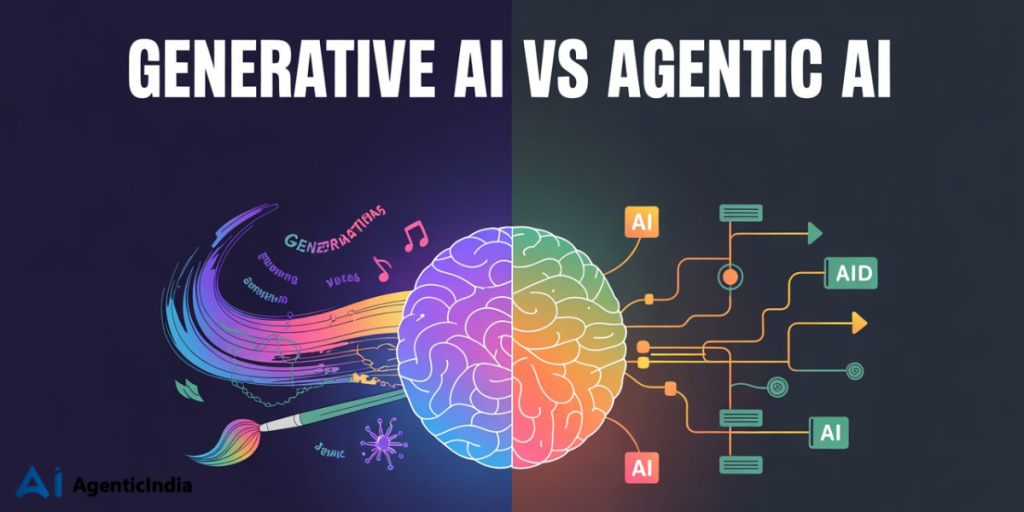
Here’s the thing. They are not. And confusing them is a bit like mistaking a paintbrush for the painter. Both are essential to creating something beautiful, but they serve fundamentally different purposes.
I spend most of my days helping companies figure out how to actually use AI, and this distinction keeps coming up. It is important for you to understand how Gen AI and Agentic AI development are different from each other. Let me break down what that really means.
Generative AI vs Agentic AI: A Practical Comparison
The artificial intelligence landscape in 2026 is really defined by understanding when you need creation versus when you need execution. Both technologies are transforming how we work, but in fundamentally different ways.
| Aspect | Generative AI | Agentic AI |
| Your Role | You act as the operator. You provide prompts, refine instructions, and guide outputs step by step. | You act as the strategic decision-maker. You define the goal, constraints, and success criteria, and the AI handles execution. |
| AI’s Role | Generates content, insights, code, designs, or responses based on your input. It reacts to prompts. | Plans, makes decisions, and executes multi-step tasks autonomously to achieve a defined objective. |
| Interaction Style | Requires ongoing back-and-forth. Each output depends on your next instruction. | You set the objective once, and the AI works independently with periodic reviews or checkpoints. |
| Tool Access | Typically limited to its internal model capabilities unless manually connected to tools. | Can access and coordinate multiple external systems such as CRMs, email platforms, databases, APIs, and project tools. |
| Memory & Context | Session-based memory in most implementations. Limited long-term contextual awareness unless specially configured. | Maintains contextual memory, tracks progress, and adapts decisions based on previous interactions and outcomes. |
| Decision-Making | Does not make independent strategic decisions. It follows instructions. | Can prioritize tasks, choose next actions, and adjust workflows to meet the goal. |
| Level of Autonomy | Low to moderate. Dependent on user prompts. | High. Operates semi-autonomously or autonomously within defined boundaries. |
| Best Use Cases | Content creation, drafting emails, generating reports, writing code snippets, summarizing data, brainstorming ideas. | End-to-end task automation, workflow orchestration, customer onboarding flows, sales follow-ups, operational process management. |
| Business Impact | Improves productivity and accelerates creative output. | Reduces manual effort, automates operations, and drives measurable execution efficiency. |
| Implementation Complexity | Relatively easier and faster to deploy using existing APIs and tools. | More complex. Requires system integration, structured workflows, governance controls, and monitoring. |
What Exactly is Generative AI?
You have almost certainly used Generative AI, even if you didn’t know that’s what it was called. Ever asked ChatGPT to help you write an email? Used Midjourney to create a weird and wonderful image? Had GitHub Copilot suggest the next line of code? That’s Gen AI in action.
At its core, Generative AI is a content creation machine. It’s been trained on massive amounts of data and learned to recognize patterns. Feed it a prompt, and it generates something new based on those patterns. It’s like having an artist who’s studied every painting ever made and can now create original works in any style you request.
The magic behind this comes from Large Language Models (LLMs). These are the GPT things you keep hearing abou. They are built on something called the “Transformer” architecture. (Don’t worry, the technical details aren’t important here. What matters is what it can do.)
What Gen AI Actually Does Well
Generative AI excels at the creative heavy lifting:
Writing and Content: It can draft blog posts, summarize documents, write marketing copy, or help you find the right words when you’re stuck. I’ve watched marketing teams use it to generate dozens of social media post variations in minutes. This was something that used to take hours.
Visual Creation: Tools like Midjourney and DALL-E can conjure up images from text descriptions. Need a “cyberpunk cat wearing sunglasses in a rainy Tokyo alley”? You got it.
Code Generation: Developers use AI assistants to write boilerplate code, explain complex functions, or debug errors. It’s like pair programming with someone who’s read every codebase on GitHub.
Data Analysis: It can look at your spreadsheets, identify trends, and explain what’s happening in plain English.
The Limitation of Generative AI
Here’s where Gen AI shows its limitations: it’s fundamentally reactive. It’s waiting for your next instruction. You ask, it answers. You prompt, it generates—this is where custom AI services can help bridge that gap.
But it won’t take initiative. It won’t remember what you talked about yesterday (unless the specific tool has memory features built in). And it definitely won’t go off and do things on its own.
What is Agentic AI?
Now we are getting to the interesting part. If Generative AI is your creative assistant, Agentic AI is your autonomous project manager. It is someone you can give a high-level objective to and trust they’ll figure out how to make it happen.
I remember the first time I saw a truly agentic system in action. A colleague told his AI agent, “I need to reduce our cloud computing costs by 20%.”
That agent spent the next several hours analyzing usage patterns, identifying underutilized resources, researching pricing alternatives, generating a recommendations report, and scheduling a meeting with the relevant stakeholders.
My colleague didn’t prompt it for each step. He just set the goal and let it run. That’s the fundamental shift. Agentic AI doesn’t wait for step-by-step instructions. It perceives, plans, decides, and acts.
What Makes an Agent Actually “Agentic”
Think of Agentic AI as taking a powerful language model and giving it superpowers:
Perception: It can understand its environment and context, whether that’s monitoring your email inbox, analyzing market conditions, or interpreting sensor data from a factory floor.
Memory: Unlike traditional Gen AI, agents remember. They learn from past interactions, track ongoing projects, and build up knowledge over time.
Planning: Give an agent a complex goal, and it’ll break it down into steps. It thinks ahead, considers dependencies, and creates strategies to achieve objectives.
Decision-Making: When faced with choices, agents can evaluate options and pick the best path forward based on the current situation.
Tool Use: This is huge. Agents can use APIs, browse the web, access databases, trigger other software, and even control physical robots. They’re not limited to generating text; they can actually interact with the world.
Where Agentic AI Shines?
Workflow Automation: Instead of automating a single task, AI agent development can handle entire processes. One company I worked with has an agent that manages their entire customer onboarding workflow from initial contact through account setup, without human intervention except for edge cases.
Complex Problem-Solving: Got a messy, multifaceted challenge? Agents excel at breaking these down and tackling them systematically. They don’t get overwhelmed by complexity the way humans do.
Adaptive Behavior: When conditions change, agents adapt. If a flight gets cancelled, your travel agent doesn’t need you to tell it what to do. It searches alternatives, checks your preferences, and books a new flight.
Always-On Operation: Agents can work 24/7, pursuing long-term objectives while you sleep. They’re particularly valuable for monitoring situations and responding to events in real-time.
The Difference in Action: A Real-World Example
Let me show you how this plays out in practice. Last month, I helped a client understand this distinction by walking them through a scenario they face regularly: planning company offsites.
The Generative AI Approach:
You sit down with ChatGPT or Claude and start prompting:
- “Suggest venues for a 50-person company retreat in California”
- It gives you a list
- “Now create an agenda for a two-day leadership offsite”
- It generates a detailed schedule
- “What team-building activities would work for this group?”
- It provides creative ideas
- “Draft an invitation email”
- It writes the email
Each step requires you to think about what comes next, prompt for it, review the output, and then figure out the next prompt. You’re doing the orchestration. Gen AI is doing the creation.
The Agentic AI Approach:
You tell the agent: “Plan and book a two-day leadership offsite in California for 50 people in March, budget $50k, focusing on strategic planning and team building.”
The agent then:
- Searches available venues matching your criteria and budget
- Cross-references your team’s calendars to find dates that work
- Compares options based on your past preferences and requirements
- Books the venue and handles contracts
- Creates a detailed agenda incorporating your objectives
- Researches and books team-building facilitators
- Schedules transportation
- Sends calendar invites
- Monitors RSVPs and follows up with non-responders
- Handles dietary restrictions and special requirements
You check in occasionally to approve major decisions, but the agent is handling the execution.
See the difference? With Gen AI, you’re the project manager using a powerful assistant. With Agentic AI, you’re the executive setting strategy while the AI manages the project.
What the People Building This Stuff Are Saying
I pay attention to what AI leaders are saying because, frankly, they’re building the future we’re all going to inhabit. And right now, they’re all converging on a similar message: agents are the next big thing.
Andrew Ng recently blew my mind with a demonstration. He took GPT-3.5 (the older, “less capable” model) and added agentic workflows to it. Then he had it compete against GPT-4 on coding tasks. The result? The older model with agent capabilities outperformed the newer, more powerful model without them. His point was clear: how you architect AI systems matters as much as the underlying model’s sophistication.
Ng talks about AI that can reflect on its own outputs, strategically use external tools, and plan multi-step approaches. Basically, AI that thinks more like how humans actually work through problems.
Source: YouTube
Sam Altman has been pretty direct about where OpenAI is headed. In his view, AI chatbots services, even really good ones, are just the beginning.
The real transformation comes when AI can manage your calendar, coordinate complex projects, and handle the kind of work that currently requires a skilled human assistant.
He sees this as the pathway to AGI (Artificial General Intelligence), where AI can operate across any domain with minimal human direction.
Source: AXIOS
Bill Gates wrote something recently that stuck with me. He predicts that within a few years, personal AI agents will become so good at understanding our needs and preferences that they’ll make a lot of today’s apps and websites obsolete.
Why would you search Google and compare prices across five websites when your agent can do all that and just tell you the best option? Why would you navigate through Amazon when your agent knows exactly what you want and can find the best deal?
Gates envisions these agents democratizing access to services; essentially giving everyone a sophisticated personal assistant. And he’s specifically said this won’t be like Clippy (thank goodness).
Source: Yahoo Finance
Practical Takeaways for Businesses (Generative AI vs Agentic AI)
I know you were here for Gen AI vs Agentic AI and not for some kind of sermon. But let me tell you how to make the best of AI.
-
Understand What You Actually Need
Ask yourself:
- Do you need content creation assistance? → Start with Generative AI
- Do you need to automate complex workflows? → Explore Agentic AI
- Is your use case somewhere in between? → Consider a hybrid approach
-
Start with Clear, Bounded Use Cases
Rather than attempting enterprise-wide transformation, begin with:
- Well-defined processes with clear success metrics
- Workflows where automation provides obvious value
- Areas where failure has limited downside
- Projects that can demonstrate ROI quickly
-
Invest in AI Literacy
For technical teams:
- Understanding prompt engineering and model limitations
- Learning to work with APIs and agent frameworks
- Developing skills in AI testing and validation
For non-technical staff:
- Basic understanding of AI capabilities and limitations
- How to effectively collaborate with AI systems
- When to trust AI outputs vs. when to verify
-
Prioritize Governance from Day One
Don’t treat ethics, security, and accountability as afterthoughts:
- Establish clear policies before deployment
- Create oversight committees for AI initiatives
- Implement monitoring and auditing systems
- Develop incident response plans
- Ensure legal and compliance teams are involved early
-
Prepare Your Workforce
Transparency: Communicate clearly about AI implementation plans and their impact
Training: Provide resources for employees to develop AI collaboration skills
Evolution: Help employees transition to roles that complement AI capabilities
Culture: Foster a mindset of human-AI collaboration rather than competition
-
Choose Partners Wisely
When evaluating AI vendors or solutions:
- Look for proven track records, not just promises
- Assess their approach to security and governance
- Understand their roadmap and commitment to the technology
- Evaluate integration capabilities with your existing systems
- Consider total cost of ownership, not just initial price
Conclusion
The distinction between Generative AI and Agentic AI represents fundamentally different approaches to leveraging artificial intelligence. Generative AI excels at creation, offering powerful tools for content generation, analysis, and creative work.
Agentic AI excels at execution, providing autonomous systems capable of pursuing complex goals with minimal human intervention.
The reality for 2026: Both technologies will play crucial roles in the AI-powered enterprise. Generative AI will continue to augment human creativity and productivity, while Agentic AI will increasingly handle workflow automation and complex task execution.
The imperative: Organizations that understand these distinctions, implement both technologies strategically, and prioritize governance and human-AI collaboration will gain significant competitive advantages.
Your next steps:
- Assess your organization’s AI maturity and readiness
- Identify high-value use cases for both Gen AI and Agentic AI
- Develop a governance framework before large-scale deployment
- Invest in upskilling your workforce
- Start with pilot projects to build expertise and demonstrate value
- Stay informed as the technology rapidly evolves
The future of AI is proactive, autonomous, and increasingly capable. The question isn’t whether these technologies will transform your industry, but how quickly you’ll adapt to harness their potential.
References and Further Reading
- Ng, Andrew. “Agentic AI Workflows and the Future of Machine Learning” – Stanford University AI Lab
- Gartner. “Predicts 2026: AI and the Future of Work” – Gartner Research
- Gates, Bill. “AI is about to completely change how you use computers” – GatesNotes
- OpenAI. “GPT-4 Technical Report” – OpenAI Research
- Huang, Jensen. “NVIDIA GTC 2025 Keynote: The Age of AI Agents” – NVIDIA
- Anthropic. “Constitutional AI and AI Safety” – Anthropic Research
Disclaimer: The AI landscape evolves rapidly. While this article reflects the state of technology and expert opinions as of February 2026, specific predictions and timelines may change as the field develops.