This week, The Wall Street Journal reported that Mark Zuckerberg is building a personal AI agent to help him run Meta. He also wants everyone at Meta to build personal AI agents specifically.
And Meta is not alone. The same push is happening across Amazon, Google and every serious AI agent development company scaling fast right now.
There are hundreds of pre-built AI agents our there in the market. But have you ever thought about why these big companies still go ahead and build their own?
It’s not because they have a bank full of money and want to burn it. There are real limitations to pre-built AI agents and real benefits to going custom.
That’s exactly what I’m going to talk about today, focusing on custom AI agents for e-commerce.
What is a Custom AI Agent for E-Commerce?
Before we get into why custom wins, let’s get one thing straight. A lot of people use the words AI chatbot solutions and AI agents like they mean the same thing. They don’t.
A chatbot answers questions. You ask where your order is, it gives you a tracking link. That’s it. It follows a script. The moment you go off script, it breaks.
An AI agent actually does things. It checks your order status, sees there’s a delay, notifies the warehouse, updates the customer and if needed, loops in a human. All in one conversation.
Now add the word custom to that.
A custom AI agent for e-commerce is built around your business specifically. Your Shopify store, your return policy, your warehouse system, your edge cases. It’s not a plug-and-play tool you configure in an afternoon. It’s built from scratch to work exactly the way your business works.
That’s the difference between a tool that fits your business and a business that has to fit the tool.
Why Pre-Built AI Solutions are Failing E-Commerce Brands
Pre-built AI tools are not all bad. If you just launched your store and you’re handling 50 tickets a month, something like Tidio or Gorgias will do the job. No shame in that.
But the moment your business starts growing, you start feeling the cracks. Here’s what actually happens:
-
They can’t connect to your systems
Most pre-built tools play well with popular platforms like Shopify or WooCommerce. But the moment you have a custom OMS, an ERP, or an internal warehouse system, you hit a wall.
The tool simply wasn’t built for your setup. So either you change your setup to fit the tool, or you work around it manually. Neither is a good option.
-
The conversation flows are rigid
Pre-built agents follow fixed flows. Customer asks something slightly outside that flow and the whole conversation falls apart.
In e-commerce, customers don’t ask clean questions. They want to return one item, exchange another and use a discount code all in the same message. Pre-built tools are not built for that kind of complexity.
-
There is no real personalization
Showing a customer their name and order number is not personalization. A real AI agent should know their purchase history, their preferences, their previous complaints. Pre-built tools sit on top of your data. They don’t go deep into it.
-
Costs blow up as you scale
Most pre-built tools charge per seat, per conversation or per resolution. Sounds fine at the start. But at 10,000 tickets a month you are paying a serious amount for a tool that still can’t handle half your use cases properly.
-
You never really own it
This one bothers me the most. With a pre-built tool, you are always a pricing change or a sunset notice away from starting over. Your conversations, your training data, your workflows. All sitting on someone else’s platform.
What a Custom AI Agent in Ecommerce Actually Does Differently
McKinsey estimates AI agents could mediate between $3 trillion and $5 trillion of global consumer commerce by 2030.
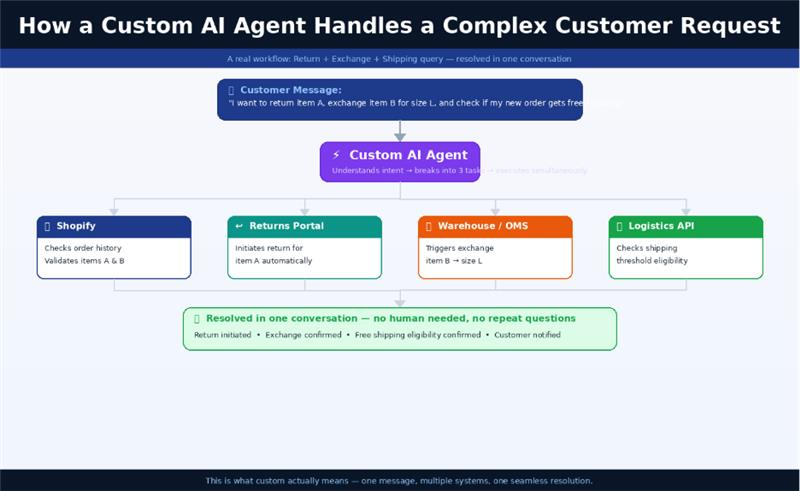
Let us talk about what does a custom AI agent actually looks like in practice.
-
It connects to whatever you are running
Shopify, WooCommerce, a custom-built platform, your own ERP, your warehouse management system. A custom AI agent is built to plug into your exact stack. Not the other way around.
If your business runs on three different tools talking to each other, the agent works across all three without breaking a sweat.
-
It handles multi-step problems in one go
This is the big one. A customer messages in saying they want to return one item, exchange another for a different size and check if their new order qualifies for free shipping. A pre-built tool either drops the ball or escalates to a human immediately.
A custom agent walks through all three in a single conversation because it was built knowing that’s how your customers actually talk.
-
It is trained on your data
There is a big difference between an AI agent that has read a million e-commerce conversations and one that has been trained specifically on your support history, your product catalogue, your return policy and your FAQs.
The second one sounds like it works for your brand. The first one sounds like a call centre script.
-
It knows when to hand over to a human
This is something people don’t talk about enough. A good custom AI agent is not trying to replace your support team. It handles what it can and escalates smartly when it can’t.
Agentic AI in customer services passes the full context to the human agent so the customer never has to repeat themselves. That handoff experience matters more than most brands realise.
-
It works where your customers are
Your website chat, WhatsApp, email, Instagram DMs. A custom agent can be deployed across all of them with consistent logic underneath. Not three different tools with three different behaviours.
Pre-Built vs Custom AI Agent: Side by Side Comparison
I know a lot of articles throw a comparison table at you and call it a day. I want to do this a bit differently. Let me give you the table and then actually explain what each row means in the real world.
| Feature | Pre-Built AI Agent | Custom AI Agent |
| Setup time | Hours to days | 3 to 6 weeks |
| Custom integrations | Limited to supported apps | Any system, any API |
| Handles complex queries | Rarely | Yes, built for your cases |
| Trained on your data | No | Yes |
| Cost at scale | Rises sharply | Predictable |
| Ownership | Vendor owns it | You own it |
| Conversation logic | Fixed flows | Built around your workflows |
| Human handoff | Basic or none | Smart, context-aware |
-
Setup time
Pre-built wins here, no question. If you need something running today, a pre-built tool gets you there faster. Custom takes time because it is being built specifically for you. That investment pays off later but it is not instant.
-
Custom integrations
This is where most brands hit the wall with pre-built tools. If your tech stack is even slightly non-standard, you will spend more time on workarounds than actual support. Custom agents are built around your stack from day one.
-
Handles complex queries
Pre-built tools are getting better at this but they are still working within fixed logic. The moment a customer request touches two or three different systems or policies at once, most pre-built tools either give a wrong answer or drop the conversation to a human.
-
Trained on your data
This one is simple. A generic AI has never read your return policy, your product descriptions or your past support tickets. A custom agent has. The difference in response quality is immediately obvious to your customers.
-
Cost at scale
Pre-built tools look cheap at the start. But run the numbers at 5,000 or 10,000 conversations a month and you will often find a custom build pays for itself within 6 to 12 months.
-
Ownership
With pre-built you are renting. With custom you own the whole thing. Your data, your logic, your workflows. Nobody can change the pricing on you or shut down the product.
Who Should Actually Build a Custom AI Agent for Ecommerce?
This is the part where most AI development companies would tell you that every business needs a custom AI agent. I am not going to do that.
Custom development is an investment. It takes time, budget and a clear understanding of what you are trying to solve. So let me be straight with you about who it actually makes sense for.
You are probably ready for a custom AI agent if:
- You are handling 500+ support tickets a month and your current tool keeps dropping the complex ones
- Your tech stack is non-standard and no pre-built tool officially supports it
- You are scaling fast and your current setup is already showing cracks
- Your customers are ignoring the chatbot and going straight to email or leaving bad reviews about support
- You have tried pre-built tools before and keep hitting the same walls.
You are probably not ready if:
- You just launched and your ticket volume is still low
- You have not figured out your own support workflows yet. Building custom too early just locks in the wrong logic
- Your budget is not there yet. I would rather tell you that now than have you invest in the wrong thing
What Does the Process of Custom AI Agent Development for Ecommerce Actually Look Like?
One of the first things people ask our AI development company is how long this takes and what they are actually paying for. Fair questions. So let me walk you through exactly how we approach a custom AI agent build.
-
The data is almost always a mess
Every client comes in thinking their support data is ready to use. It never is. Tickets are miscategorised, FAQs are outdated by two years, return policies have been changed three times and nobody updated the docs.
Before we build anything we spend real time just cleaning and organising. This is unglamorous work but it is the difference between an agent that sounds sharp and one that confidently gives your customers wrong information.
-
Your edge cases are more common than you think
Every business says they have a few edge cases. What they actually have is edge cases making up 30 to 40 percent of their total ticket volume.
A customer wanting to split a return across two orders. A wholesale buyer asking a question through the retail chat. A refund request on an item bought through a third party marketplace.
These are not rare. They are just invisible until you start mapping them properly. A custom build forces you to confront them. Pre-built tools just bounce them to a human and nobody notices the pattern.
-
Integrations break in weird places
On paper the API connection looks clean. In practice, your OMS returns data in a format nobody documented, your logistics provider has a rate limit nobody mentioned and your Shopify webhooks fire twice under certain conditions.
This is normal. But it means the integration phase always takes longer than expected and anyone who quotes you a fixed timeline without doing a proper technical audit first is guessing.
-
The handoff to humans is where most agents fail
Everyone focuses on what the AI handles. Nobody thinks hard enough about what happens when it cannot handle something. A bad handoff means the customer repeats their entire problem to a human agent who has no context.
That experience is worse than having no AI at all. Getting the escalation logic right, passing the full conversation context, flagging the right urgency level, this is where we spend a disproportionate amount of time and it is almost always invisible to the client until they see it working.
-
The first two weeks after launch will humble you
No matter how well you tested, real customers will find gaps you never imagined. Someone will ask a question in a language you did not account for. Someone will paste a screenshot instead of typing.
Someone will ask about a product you discontinued eight months ago. This is not failure. This is data. The agents that get really good are the ones where the builder stays close after launch and iterates fast. The ones that go stale are the ones where the client treats go-live as the finish line.
Conclusion
Look, I am not here to tell you that every e-commerce brand needs a custom AI agent. That is not true and you would see through it anyway.
What I am saying is this. Pre-built tools are built for the average business. If you are average, they work fine.
But if your business has grown past average, if your stack is non-standard, if your customers are having a bad experience and your team is still drowning in tickets despite paying for an AI tool, then the problem is not your team. The problem is the tool.
Custom is not a luxury. At a certain point it is just the more logical choice.
We have built custom AI agents for e-commerce brands that have outgrown what pre-built tools can do.
If that sounds like what you need, let’s have a straight conversation about it. Tell us what is broken and we will tell you honestly whether a custom build makes sense for you or not.
Fifteen minutes is enough to figure that out.
FAQs
How much does a custom AI agent for e-commerce cost?
A basic custom AI agent with two or three integrations starts from a few thousand dollars. Something more complex with multiple system connections, multi-channel deployment and custom logic can go significantly higher. The range is wide because the scope varies enormously from business to business.
What I would say is this. Run the numbers on what you are currently spending on your pre-built tool plus the manual work your team is still doing around it. Most clients find the custom build pays for itself within 6 to 12 months.
How long does it take to build a custom AI agent?
A straightforward build takes 3 to 5 weeks. A complex one with multiple integrations and channels takes 6 to 10 weeks. Anyone quoting you a fixed timeline without first doing a proper technical audit is guessing.
Can a custom AI agent integrate with Shopify?
Yes. Shopify is one of the more straightforward integrations. Where it gets interesting is when you need the agent to talk to Shopify and your custom returns portal and your third party logistics provider all at once. That is where pre-built tools struggle and custom builds shine.
Is a custom AI agent better than Tidio, Gorgias or Zendesk AI?
Not always. If your store is early stage and your support needs are straightforward, those tools are perfectly good. But if you have a complex stack, high ticket volume or workflows those tools cannot handle, then yes, a custom agent will outperform them in every meaningful way. The honest answer is it depends on where you are in your growth.
What happens if the AI agent gets something wrong?
This is a question more people should ask. A good custom agent has clear escalation logic built in. When it is not confident about an answer it hands off to a human rather than guessing. The handoff includes full conversation context so the customer never has to repeat themselves. Getting this right is one of the most important parts of the build.